Showing posts with label nclb. Show all posts

08 January 2013

Must IRBs Crack Down on Educational Researchers?

Where is the look at “side effects” so essential to the “medical model?”
“There really is no “science” in educational research, nor should there be. To do scientific studies we need to be able to actually control the variables – and we can’t in education. There are just too many of them. Also, to do stats we need numbers – volume. There are few studies where N is large enough to warrant statistical analysis, but they do them anyways and the results get used as though they have some validity.

“Academia and formal education have subscribed to the notion that anything “scientific” is better than anything that isn’t, so we bend and stretch the notion of the scientific process to the point that it becomes meaningless. Adding the word “Science” to something doesn’t make it so. Very few things are actually sciences. Social Science is NOT a science. Nor is computer science (or math), for that matter.

“So long as we keep pretending that we are doing ‘science’ in Ed Research, we will not make any real progress.” - Katrin Becker
If educational research is a “science,” what does that mean? What, specifically, does it mean for those who conduct educational research? And if educational research is science, must it not carry the same obligations which bedeviled, say, Einstein and Oppenheimer?

What are the rules? What are the ethics? What are those obligations?
IRB training always refers to the lack of informed
consent in the infamous Tuskegee Experiment

For now, what does “informed consent” look like in educational research? What do ethics suggest about the possible “side effects” of research on children?

What should, for example, a university IRB (Institutional Review Board, the way universities approve research projects and oversee ethical treatment of human - and other - research subjects) demand from a faculty member or student researcher in terms of information and ethical expectations before that researcher can participate in studies which have the potential to harm young people? And what kinds of research must be evaluated for that potential harm?

The lack of “package inserts” and nationally advertised side effect warnings haunts the field of educational research and, along with the inability to create “double-blind” trials, makes a joke of that field’s pretenses towards the “gold standard” “medical model” of research imagined by 2002’s troublesome guide, Scientific Research in Education.

In the United States, the faux “medical model” of research in education has been the ‘law of the land’ since 2001. According to the US Department of Education, through both the No Child Left Behind legislation and the “What Works Clearinghouse,” educational research is defined by:
“Randomized, controlled, experimental studies, using the medical model of research.
“Not matched comparisons.
“Not quasi-experimental designs.
“Must establish causality, ruling out plausible explanations.
“Small, focused “interventions.”
“Limited teacher professional development components.
“Short-term.
“School patterns are not changed.
“Students are the unit of assignment, not classrooms or schools.
“No contextualization.” -
Ellen B. Mandinach and Naomi Hupert (powerpoint download) EDC Center for Children and Technology edc.org/CCT 
But this is one of those conundrums. The “Medical Model” being defined by one impossibility in education, that double-blind trial, and one thing educational researchers traditionally refuse to acknowledge, the side effect.

If indeed that “double-blind” trial - where neither subject nor experimenter knows who is receiving an intervention - is even possible in medicine. To quote Michael Barbour (responding to a Newsweek article):
“This article is a crock – as it continues the myth of the double-blind, quasi-experimental model as the gold standard. Unfortunately educational research has often been driven by what will be funded or, in the case of unfunded research, what is easy to accomplish. In both instances this has resulted in poor research – and as long as the method of medical research is used as the measure of what we consider good or what we consider as working (as evidenced by the “What Works Clearinghouse” – another laughable initiative), educational research will get no better.

“What folks won’t tell you is that the double-blind quasi-experiment model isn’t blind. Real medications have side effects, sugar pills don’t. Real medications often have scents or textures that placebos don’t, to the point that in most instances those administering the treatments know whether a patient is getting the medication or the placebo.

“Let’s also not forget that most medications work with the body and in randomized instances, most differences in bodies will be a wash. This is not the case with educational research, as while a randomly selected group of students has the same chance of having a higher percentage of free or reduced lunch students in both the treatment and the control groups, it doesn’t guarantee it. But any noticeable difference in the percentage of this population in your two groups should yield widely differing results, regardless of the instructional intervention.

“This is why many folks have begun to argue that design-based research (also called developmental research) is the direction we should be heading. The problem is that no one will fund a study that is designed to address local situations, and not designed to be generalizable.”

That other issue? The warnings? Those “package inserts”? “All ideas are dangerous,” said my friend and collaborator Dr. Greg Thompson on Twitter the other night as we discussed this, but maybe certain ideas and experiments present greater immediate risks than do others. If scientists genetically modify animals or plants, can they control the spread of that invented mutation before they understand the risks fully? If a pill will put the user to sleep don’t we generally advise that, “this formula may cause drowsiness, if affected do not operate heavy machinery or drive a vehicle"?

In a first-year doctoral program course Dr. Robert Floden of Michigan State University presented us with a study he seemed to think was really good. It was a study by Dr. Robert Slavin of Johns Hopkins University and his collaborators of their Success for All reading program, one of those “gold standard,” “medical model” programs endorsed by the US Department of Education. Floden was upset when we challenged the report’s validity, but challenge it many of us did. One woman wondered if the effects seen were not a result of providing food to students throughout the day, or of increased time devoted to reading (effects not ruled out in the study). Others, including me, wondered about long-term interest in reading after being trained to read via chanting. Many of us wondered about the “pharma model” of research being conducted by those with a financial stake in the product’s success (Stockton, California spent between $4.6 million and $6 million to implement Success for All for one year). Still others wondered about psychological impacts, and I perhaps heightened tension in the room by suggesting that a program like this might, in a classroom of thirty kids, “improve reading scores for eight and cause two to kill themselves.” Inelegant, but a valid question even though my professor dismissed it. (Success for All, and its research base, has been challenged by others)

This week Macgregor Campbell, a New Scientist researcher and writer, brought this issue back to the fore for me, as I received a link to his article on TIMSS testing, West vs Asia education rankings are misleading, on the same day I received an email from a former professor and globetrotting TIMSS researcher.

If, as Campbell writes, those nations focusing on TIMSS results created demonstrably worse outcomes for children, what potential damage are TIMSS researchers doing to the children I work with in the United States and Ireland - two nations with political leaders deeply concerned about TIMSS results - or to hundreds of millions of children around the world?
“In 2007, Keith Baker of the US Department of Education made a rough comparison of long-term correlations between the 1964 mathematics scores and several measures of national success decades later.

“Baker found negative relationships between mathematics rankings and numerous measures of prosperity and well-being: 2002 per-capita wealth, economic growth from 1992 to 2002 and the UN's Quality of Life Index. Countries scoring well on the tests were also less democratic. Baker concluded that league tables of international success are "worthless" (
Phi Delta Kappan, vol 89, p 101).”
Lower prosperity, lower measures of well-being, less economic growth potential, less likely to live as citizens of a democracy. I considered this alongside the warnings I often laugh at in televised pharmaceutical advertisements. Will a focus on the skills necessary for TIMSS success cause democracy to fail? Most likely not. Nor have many meds with dangerous side effects hurt me when I have taken them. But other side effects may be far more common.


Anti-Depressive television advertisement. Which "sexual side effect" will help cure depression?

“The 2012 TIMSS report immediately identifies East Asian countries among the top performers in TIMSS 2011. Also high percentages of East Asian students reach TIMSS international benchmarks. Benchmarks are classified by score as low, intermediate, high, and advanced. These are arbitrary and do not have any basis in research. They are simply a way to differentiate and classify test ranges. The media focus on findings such as these, and leaves the impression that comparisons across countries are valid, and helpful. They are not,” writes Dr. Jack Hassard of Georgia State University. If these measures lack validity, and they are used to help set local and national educational policies, are they potentially dangerous?

If an Irish 5th grader finds her school day more devoted to mathematics computation because her nation fared poorly on a TIMSS test, and has less time for questions of passionate interest - including non-computational maths - might there be damage? And if there is damage, who is responsible? Who has sought the “informed consent” of this student? Who will be held accountable if she abandons an interest in conceptual mathematics and thus limits her future earning potential?
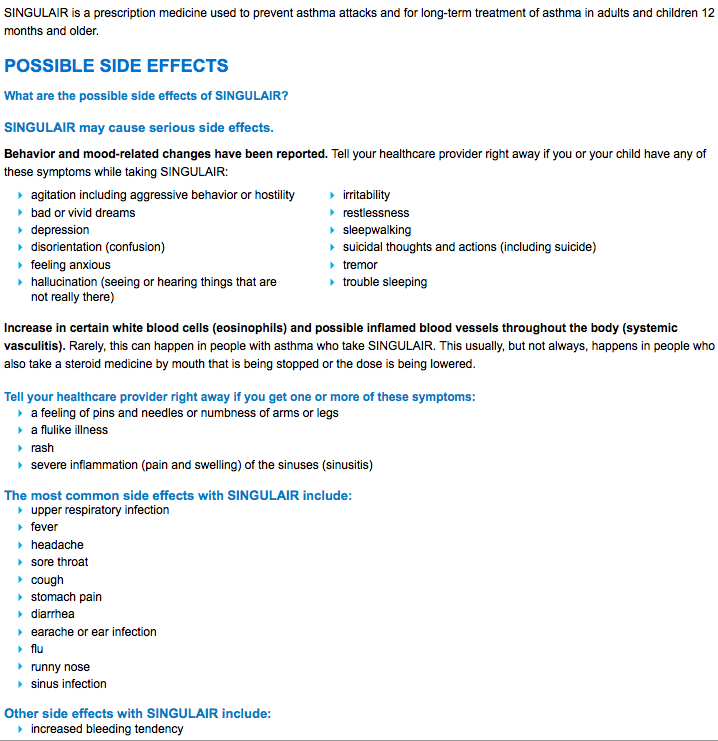

Asthma drug possible side effects. What warnings might appear with educational policy interventions?

This is not an idle, hypothetical question. Research on TIMSS often quoted by Yong Zhao suggests that “there is a negative correlation between TIMSS scores and how much children enjoy mathematics and how confident they are in their abilities.” Thus, if Ireland’s education minister Ruari Quinn encourages his teachers to push to raise TIMSS scores, that result may be likely to occur.

A Brookings Institution report on PISA test results notes that soon after that 2006 international comparative reading test’s results were reported the World Bank began pressing for nations to alter their educational programs. “Soon after, a World Bank study pressed harder on the theme of causality, “Poland’s reading score was below the OECD average in 2000, at the OECD average in 2003, and above the OECD average in 2006, ranking 9th among all countries in the world…. With regard to the factors responsible for the improvement, the delayed tracking into vocational streams appears to be the most critical factor.”

But the causality suggested by the World Bank is simply not a truth. The Brookings report goes on to note that many of the nations involved in the PISA test showed similar gains among similar populations, though none of the World Bank’s causal interventions (which involved tracking) were involved in those other cases. In fact, other research indicated the issues created for many students by Poland’s particular approach to tracking. Now, the World Bank is a political organization, not an academic institution nor a research organization, but what of the academics who work for this organization? These researchers often are affiliated with major American and British universities, from Harvard “on down.” What, exactly, did they disclose about their research?

The issues for educational researchers stretch far deeper. Those involved in the development of America’s No Child Left Behind, and those involved in the work of organizations such as the Gates Foundation and the Broad Foundation which support government testing schemes, should have their own ethical concerns. Testing, specifically standardized, high-stakes testing, has serious and significant side effects which threaten the health and safety of children, and which routinely go undisclosed by the educational faculties of US universities.

“Much of the debate surrounding standardized testing is focused on the effects the testing atmosphere has on teachers and students. Negative side effects are associated with teacher decision making, instruction, student learning, school climate, and teacher and student self-concept and motivation. The tests have turned into the objective of classroom instruction rather than the measure of teaching and learning. Gilman and Reynolds (1991) reported sixteen side effects associated with Indiana’s statewide test, including indirect control of local curriculum and instruction, lowering of faculty morale, cheating by administrations and teachers, unhealthy competition between schools, negative effects on school-community relations, negative psychological and physical effects on students, and loss of school time.

“Testing anxiety related to these assessments affects all populations associated with the institution of education, such as students, teachers, administrators, and parents. Research reports that elementary students experience high levels of anxiety, concern, and angst about high-stakes testing (Barksdale-Ladd and Thomas 2000; Triplett, Barksdale, and Leftwich 2003). Triplett and Barksdale (2005) investigated students’ perceptions of testing. They concluded that elementary students were anxious and angry about aspects of the testing culture, including the length of the tests, extended testing periods, and not being able to talk for long periods of time.

“Student anxiety increases when teachers are apprehensive about the exams (Triplett, Barksdale, and Leftwich 2003). When students are drilled every day about testing procedures and consequences, the fear of failure prevails.” -
Dr. Theoni Soublis Smyth, University of Tampa

My goal here is not to halt this kind of research, but to ask “educational researchers” and the review boards which monitor them, to own their responsibilities. I believe this begins with self-acknowledgement. We work in a field which involves the most vulnerable members of our human population, but we do not behave as if that is true. We constantly perform experiments on children with very, very little information given to the children, their parents, or even their teachers. We speak as if we “know,” when we usually do not. And in doing so we suggest to leaders - people like Barack Obama and Michael Gove along with thousands of local school administrators - that there are simple and definitive answers - that, for example, we might build a national database called “what works.”

Children are hurt daily by the actions of educational researchers. A child made miserable in classes with Success for All - perhaps a reasonably “achieving” student
for whom SFA has never been shown to have any benefit (pdf download) - may find reading a ‘waste of his time,’ or may end up feeling that way about school in general, and that is a child harmed. A student made miserable by a testing regime, or who has their self-image redefined by a test, is harmed. A student whose teachers and administrators are panicked by potential test results is harmed. These are real dangers. Real threats to real kids, and at the very least, “we,” those of us in this field, must be much better at disclosing these facts to everyone impacted by “our” work.


Alain Resnais, 1959, Hiroshima Mon Amour, where Einstein and Oppenheimer
carried us?

All ideas, as Dr. Thompson noted, are dangerous. And all research is dangerous as well. Albert Einstein set about discovering the forces at the root of our universe - powerful, brilliant, positive research, but research which somehow found a conclusion at Hiroshima. A real attempt to help solve the horrors of severe arthritis pain led to the Vioxx nightmare. Many American university researchers contributed to the disasters created by No Child Left Behind and Scientific Research in Education, a legacy only Diane Ravitch seems to have struggled with. My early work - back in the last century - which often suggested single “best assistive technology solutions” was flawed, and, I am sure, hurt students who had needs other than those I had considered. And so, perhaps, we all had responsibilities to warn people about the potential for harm, but none of us did.

This should not stop ideas, and it should not stop research. But it should give us all pause, and perhaps those overseeing our research should demand more significant, and more reflective pauses. These are children, and they are our responsibility.

- Ira Socol

02 January 2013

Christmas, Zombies, the Common Core, Neoliberalism, and Democratic Voice

On the F train on Christmas Eve my spousal equivalent, born and bred in the Protestant American heartland, turned to me and said, "I'm the only blond in this car." "Probably on this train," I answered.

In New York City Subway art, tourists (and odd old women) are denoted by blond hair
And I recalled how, in the decade previous to this one (when the century was new) I asked - in front of a classroom full of young teachers to be - for all those students with blond hair and blue eyes to stand up.

"You know," I then told this Midwestern grouping, "it is more common today for a child to be born with AIDS than with blond hair and blue eyes." Then I paused, let them sit down, and we began to wonder about how we define "the other" and about how we define "normal."


I do not know if it is indeed, "more common today for a child to be born with AIDS than with blond hair and blue eyes," which I later indicated to the students and asked them if they might use their phones to find an answer, but, you probably get the point.

Which brings me to stories from my niece, a New York City schools teacher in an elementary school in the Borough of Queens. She told two theologic-confusion stories from her incredibly diverse student population:
At Christmas 2011 a boy from India asked why Christmas was such a big holiday. "You do all this because one god had one baby?" "Well, we only have one God," my niece replied, and there is only one child. This didn't really help solve the boy's confusion.

*****
At Easter 2012 a boy from China tried to figure out that holiday. When my niece tried to explain the resurrection, the boy said, "So he was alive, then he was dead, then he was alive again?" "Yes," my niece replied. "Ohhh," the boy said, holding his arms out straight in front of him and waving them up and down, "Zombie Jesus."

"You can't do that anyplace else in the school," my niece told him when she stopped laughing, "people really believe this." "Grown ups too?" he asked. "Grown ups too," my niece said. "Which grown ups?" he asked, wondering, of course, who in this American school he might be able to trust.
"Our" Anglo-American-Christian "core beliefs" are, quite often, a baffling mythology for others. As are "our" (essentially) religious commitment to market capitalism, "our" belief in linear - point A to point B - storytelling, and "our" (American) ignorance of history or "our" (English) refusal to acknowledge history. These accepted "norms," these structures of thought, which lie at the heart of the American "common core" and the English "e-bacc" of Michael Gove, and the "educational reform" efforts in the US, Canada, England, and Australia, are the very things which put our "Nation[s] at Risk." They are not a solution, they are the problem, and always have been, going back to the era in which public (or, in England, "state") education was created.
"America has long been known–despite our problems–as the country of freedom, innovation, and wealth.  There are several reasons for this, not the least of which is our democratic and free public education system.  Prior to NCLB in 2002 and Race to the Top eight years later, standardization was limited to SAT and ACT tests, NAEP and PISA tests, and graduation exams for Advanced Placement courses.  We valued music, art, drama, languages and the humanities just as much as valued science, math, and English (for the most part).  We believed in the well-rounded education.

Now, the Common Core State Standards has one goal: to create common people.  The accompanying standardized tests have one purpose: to create standardized people.  Why?  Because the movers and the shakers have a vested interest in it.  It’s about money and it’s about making sure all that money stays in one place." - Kris A. Nielsen 2012
Do we want "common people"? or is this effort by those with money and power, from ALEC to Bill Gates to Eli Broad to Goldman-Sachs, "how democracy ends" as the teacher quoted just above says?

Venn Diagram by Kris A. Nielsen
Democracy, like invention, requires uncommonalities, requires difference. Invention comes from (a) discomfort, combined with (b) thesis (an idea of how to solve the discomfort) plus (c) antithesis (a challenge to the thesis based in differing views), which leads to (d) synthesis - that new idea. Democracy, of course, in order to be democracy, requires constant invention, based in constant discomfort with how things are, combined with radically differing competing world views. Democracy is essential for invention, because it allows challenge to ideas. Invention is essential to democracy, because it allows creation of new answers. And our educational reform concepts, our Common Cores and E-baccs, allow neither to exist. And those who embrace these "answers" without apology are opposing all that is good about our nations and our economies.

My Venn Diagram of forces shaping US public education in 1850, the "Prussian Model"
imported by Henry Barnard was originally developed to ensure consistent training in
obedience for future imperial troops, and to discover potential fully-compliant low level officers.
The British Empire version looks slightly different in 1860: "Democracy Doubters"
includes those preserving unequal voting and the House of Lords, and "wealth schools"
represents the English "public school" (private) system.
What these diagrams share is the commitment to compliance and a matched citizenry which is easy to sell to and easy to derive labor from. What the resulting schools share is a failure to allow human accomplishment. It is important to note that even the very "best" American institutions of education could not hold Sergei Brinn or Bill Gates or Mark Zuckerberg - people of ambition with all the gifts of American wealth. Even the most "radical" of American colleges could not hold Steve Jobs. But this is not new, Alexander Hamilton could not gain admission to The College of New Jersey (now Princeton University) and dropped out of Kings College (now Columbia University). Scott Fitzgerald could not handle more than half a day of primary school and dropped out of Princeton. Frank Lloyd Wright never graduated from either high school or university. The education systems we have inherited from that mid-19th Century have consistently, and intentionally, restricted who is allowed to succeed. We can easily build long lists of dropouts who have found great success - often because family wealth or connections allowed them alternative paths - but the biggest tragedy are the millions and millions dumped by these systems who found nothing but despair, mixed with the even greater number of millions who "succeeded" in these systems only to find the meaningless of mediocrity and powerlessness.

If American education has been successful at all, as Yong Zhaoargues, it is because teachers and building and local administrators have subverted the system, not because they have followed or embraced it.
"Dr. Zhao grew up in China and immigrated to the US in the 1990’s. From his perspective he sees that China seems to want an education that America seems eager to throw away. This is one that respects individual talents, supports divergent thinking, tolerates deviation, and encourages creativity. At the same time, the US government is pushing for the kind of education that China is moving away from. This is one that features standardization of curricula and an emphasis on preparing students for standardized tests. He wonders why Americans who hold individual rights in high regard would let the government dictate what children should learn, when they should learn it, and how they are evaluated."

Yong Zhao at ISTE 2012

It is the rule-shattering schools, from Summerhill in England to the 3Is and Parkway School of the 1970s, to low-compliance schools like SLA and Monticello High School today which have always produced the most interesting, most culturally competent, most innovative students. Those schools have/had a shared cultural commitment to freedom and democracy, to difference and synthesis. They are focused on educating all kinds of students with communal support, not focused on the neoliberal ideal of creating an all-the-same population based solely on individual resources.
"Neoliberalism is an ideology and set of policies that privilege market strategies over public institutions to redress social issues (Kumashiro, 2008). Such policies champion privatizing formerly public services, deregulating trade, and increasing efficiency while simultaneously reducing wages, deunionizing, and slashing public services (Martinez & Garcia, 2000; Tabb, 2001). Neoliberalism defends the rights of the individual and uses the ideology of individual choice to promote the idea of a meritocracy “that presumes an even playing field” (Kumashiro, p. 37). Unfortunately, within education, these policies work to challenge the legitimacy of public schooling by promoting vouchers, charters, and other quasi-private schools while privatizing services that were once the domain of public institutions, such as curriculum development and testing (Lipman, 2005). By focusing on the rights and responsibilities of individuals, neoliberal policies have resulted in increasing accountability systems that place blame and punishment on individual students and teachers rather than on the inequitable school systems that have inadequately served them. Rather than improving quality of education, this vicious circle creates school climates characterized by compliance, conformity, and fear." Bree Picower 2011
"Compliance, conformity, and fear," the toxic mix which is product of the "common core," of the directives of Michael Gove, of "educational reformers" from Wall Street to Sydney. This is "the place" where kids who sit still in chairs for three hour long exams are the norm. Where everyone finds the the same plot and the same theme in the same stories, even if the plot is irrelevant. Where every kid always raises their hand before speaking and happily stares straight at the eyes of every authority figure. Where every child dreams of growing up to be a blond, blue-eyed, straight, protestant, just like the dolls we sell them.

2006 film, "The Water is Wide" from Pat Conroy's first (originally self-published) book.

Somewhere out there we need more teachers, more administrators, more parents, and more citizens who, despite their own educations in compliance, will challenge this. Who will say that "we." like all successful human societies, need differences, need diversity of views, need creativity, need play, need imagination, need refusals to conform.

Somewhere out there we need more heroes. Educators, parents, citizens, humans, who will take the risks needed to create a better place for kids, rather than just 'going along' that path of least resistance.

Here, today, in the middle of the Twelve Days of Christmas, when we celebrate, yes, just one child of one god, is a good time to recall that building an earthly heaven requires risk and sacrifice, and not risk aversion and compliance.

- Ira Socol

17 December 2009

The Carnegie Unit

"Thus, the Carnegie Foundation for the Advancement of Teaching encouraged the adoption of what came to be known as the Carnegie unit, which equates seat-time with learning. Each unit represented about 130 instructional hours. The Carnegie Foundation defined a unit as a course that met for a period each school day for about 50 to 55 minutes. The Carnegie unit continues to influence much that is crucial to teaching and learning in high schools–the length of the class period, the school day and the school year, as well as the time expended to receive a diploma." - StateUniversity.com

Does "time in seat" equal learning? Few have ever been sure, and I need to say, those who spurred the development of Carnegie Units between 1885 and 1915 were not sure.

Sitting in a chair and staring straight ahead is learning. The more we do do that, the more we learn. If that seems to be the underlying theory in your school, it is neither an accident of history nor a natural development. Rather, it is the result of a deliberate set of decisions made by business and educational leaders beginning about 120 years ago.

Back at the turn of the last century The Carnegie Foundation took standardization seriously. America's education system was already an oddly configured one, funded and operated locally - usually very locally - in often tiny school districts operating according to the cultural norms of wildly disparate population groups: America never quite embracing "nation" status within (a "single people") no matter how much "America" looked like an "idea" from abroad. As vast the differences which might lie between educational aspirations in Cornwall, Newcastle, and London (in England - which remained America's cultural model), or Bonn, Konigsberg, and Berlin (in Prussia - which was perceived as the model of modernity and efficiency), they paled beside the differences separating Salt Lake, Montgomery, and Boston - much less the thousands of miniscule towns hosting one-room schoolhouses across the vast North American continent.

Schoolhouses in Lincoln County, Kansas circa 1900

So for more than half a century, since the 1840s, the US had wrestled with the problem: They wanted the Prussian model - an efficient, universal, education system which would both knit a diverse "empire" together (as in historically separate and religiously diverse "Germany") and properly prepare the lower classes for compliant citizenship and labor - but - they lacked the central control authorities of European nations.

If schools were to develop American citizens and workers and, in Jefferson's theories, discover who was deserving of publicly funded advanced training, could all decisions really be left to local school boards?

"A bill for the more general diffusion of learning... proposed to divide every county into wards of five or six miles square;... to establish in each ward a free school for reading, writing and common arithmetic; to provide for the annual selection of the best subjects from these schools, who might receive at the public expense a higher degree of education at a district school; and from these district schools to select a certain number of the most promising subjects, to be completed at an University where all the useful sciences should be taught. Worth and genius would thus have been sought out from every condition of life, and completely prepared by education for defeating the competition of wealth and birth for public trusts." - Thomas Jefferson to John Adams, 1813. ME 13:399

The first attempts to create standardization were, naturally, through education. Educational journals appeared - almost always containing at least one monthly study of Prussian methods - to disseminate "best practices." "Normal Schools" were established to train teachers in those "common norms" of instruction, behavior management, and content knowledge. Some states went further: by the late 1860s New York State already had standardized exams for secondary knowledge based in European models, though in most places curriculum remained a purely local decision.

Thus, defeating Jefferson, universities were left to find the "genius" through very imperfect methods - or through wealth and birth. Post-secondary institutions devised their own admissions tests or strategies for those available spaces not given to the children of wealth and power. Who deserved the ultimate in education? In an age increasingly dominated by complex technologies, in which nations competed in inventiveness and creativeness (think Marconi, Tesla, Wright, etc.), how would genius be uncovered, trained, encouraged?

At Harvard the issues began to be raised to a new level. Charles W. Eliot, Harvard's President for 40 years (1869-1909), didn't think much of his institution's oral comprehensive admissions examinations. He also thought that education, like manufacturing, would benefit from standardization. Why might Student A, studying with Professor X, read twice as much as Student B, studying with Professor Y? How could either the newly appearing post-graduate schools, or employers, judge that?

So Eliot pioneered both the "contact hour" and the idea of "credit distribution." The former was seen as a way of proving work - work in America (outside of agricultural labor and women's piecework) was now routinely judged in hourly terms rather than accomplishment. The latter meant that students would be exposed to both the "classics" (which had dominated universities) and the contemporary mechanics and sciences (which had risen in importance since the appearance of the Land Grant College).

Michigan Agricultural College's "Laboratory Row" in 1912

And then, as now, industry and big business joined in. For business, consumed with standardization, industrialization, efficiency, and preparation of future workers, creating an effective training structure - replicated across the nation as, say, time zones had been, was essential. So, into the fray came the Carnegie Foundation, funded by the biggest businessman of them all, Andrew Carnegie.

That is not to say that all the goals of the Carnegie Foundation were evil. As in most things, there was a mix of limited world view and good intentions. The people surrounding Carnegie were envisioning a meritocracy based firmly in the Protestant work ethic. They saw themselves as creating a Horatio Alger-esque path to success through doing well in school via "objective" standards. Exactly the same motivations which lie behind No Child Left Behind legislation and much of the American charter schools movement.

A student in western Nebraska would, under the Carnegie formula, have the same four years of high school with essentially the same seat time on various subjects as a student in New York's leafy suburbs. A student studying chemistry at a university in Iowa would have the same four years of study with essentially the same seat time as a student studying chemistry at Harvard. It was all democratic and scientific. We would measure what was measurable.

A key Carnegie Foundation key report of the time, written by publishing executive Morris L. Cooke, was titled Academic and Industrial Efficiency, if we needed further evidence of the point. Education would be structured by time card. Education would be standardized. Education would be national.

Today

The Carnegie Unit lives with us today - truly, nothing structural has changed in US education since 1910. We still measure academics via seat time. We count our credits - both at the secondary and post-secondary level - by hours spent "in instruction" on specified subjects. Does it cripple us? Does it truly block reform? Does it prevent interdisciplinary instruction or open schooling?

"The unit affects the very way that knowledge is organized for instructional purposes, discouraging interdisciplinary teaching because of the difficult question of deciding how many units to attribute to each discipline. Those who would organize and convey knowledge differently inveigh against the "tyranny" of the Carnegie unit, asserting that seat-time is not a proxy for learning and that secondary schools must be flexible to engage students and to heighten learning." StateUniversity.com

The Carnegie Unit is a tyrant, but its tyranny is felt through attitude, not really through force of law. We see the power of the Carnegie divisions of knowledge because that is all most of us know. There are lots of ways around this.

My tenth grade "English class" and my tenth grade "Social Studies class" were one internship with the late night radio guy on WVOX-AM. Two nights a week I'd walk over to the "K" building in New Rochelle, NY and head down to the basement studios. There, I'd spend for 2 or 3 or 4 hours with the crazy overnight news guy. We'd ride around in the station's Vista Cruiser looking for news, or sit at the tape machines editing interviews, or grab stuff off the AP and UPI teletype machines. What did I learn? I learned editing (though not in print). I learned writing (though orally). I learned how news was constructed. I learned how radio actually worked. I learned how politicians spoke, and what news readers did not report from those conversations. I learned the structure of my "home town" in a whole new way. It was powerful stuff.

And in the end I signed off on my hours - more than enough, and claimed the two Carnegie Units. Yes, I had to take Regents Exams to complete the credits, but that simply involved a couple of weeks of nonsense fact cramming. I passed both - barely - but who cared? But if I hadn't, the problem would have been the standardized test, not the Carnegie Unit. Students in my high school picked up biology Carnegie Units working in the hospital or the city greenhouse, math Carnegie Units working with surveyors or architects, English Carnegie Units reading on their own or writing for the school newspaper - often two or even 3 to a year-long project or independent study. Even the courses we had challenged the Carnegie structure while operating within it.

In other words, Carnegie Units are a bad idea in practice, but they are not the real problem. Our problem is our lack of imagination - and our unwillingness to take real risks in changing a broken system.

Kill NCLB, kill the standardized test, kill the Carnegian/Bushian/Obamaesque belief in all children learning at the same rate, and you will break the essential chains holding back education.

But the Carnegie Unit - yes, it is an unfortunate remnant of good intentions run amok - but it is also a very easy roadblock to walk around.

- Ira Socol

13 June 2009

Evaluate that!

My son went to a great high school. Among the things they did was combine grades with long narrative evaluations. This allowed me to see the great conundrum of educational evaluation in a unique way.

For at the end of his 9th grade year his Latin Class evaluation read (in part) this way: "[He] was the best student in the class, he completed both Latin I and Latin II this year. He will need to take future courses at [a nearby] college in order to continue his advancement. Grade C-"

"What grade," I asked the teacher, "did the second best student get?"

I was told that my son got a bad grade because he did not do his homework. "Apparently," I said, "he didn't have to." But, you see, this teacher had a rubric. Homework was 25% of the grade, and apparently there was no block in the rubric for doing two years of work in one.

I didn't really fight. I didn't care. The next year he was sitting among college students reading Ovid. That's what matters.

Except, that is not what matters.

"Can I write "Dear parent, your son has greatly improved on things not considered important by the school [reporting] system"?" Tomaz Lasic asked on Twitter today. Mr. Lasic is a teacher in Western Australia dealing with "troubled" children, and a brilliant observer of the system. He followed up: "in my 'low achievers' class. Where's "halted [self]abuse", "began to smile" box to tick?" And: "Every time a particular kid (totally socially inept past) walks in our office and says please, or gives a hi-5, we say: "Evaluate that!"
What is our national standard (whatever nation you are in) for getting a child to smile? For getting a child to publicly ask a question? For getting a child to confidently present an idea? For getting a child to be willing to ask for help? Or to ask to play with another child?

What is the national statistical trend line for feeling safe in school? For picking up that first book of interest? For solving an interpersonal problem for the first time? For absorbing an unfair call in athletics without going off?

There are so many things we hope children get from their education, but when we discuss "data driven decision making," or "accountability," or "standards," or "merit pay" for teachers we become complete reductionists, assessing (very badly) a tiny fragment of all that expected learning. And in doing this we tell children they are worthless, and we assure that success in school is a matter of socio-economics and playing the "those-in-power" game, and nothing else.

See, it does not matter if a child is rushing ahead or struggling to keep up. We do the same thing to anyone who doesn't measure up to our fictional "average." We crush them, demean them, and sneer at their accomplishments. And in doing so, we prove our worthlessness and lack of credibility to virtually all students.

So when people talk about measurement in education, I always get angry, because I know that neither Arne Duncan nor Michelle Rhee would give a dime of merit pay to Mr. Lasic for helping that kid learn to smile, nor even to that Latin teacher for letting my son rush ahead. And I know that schools which must spend years making their children simply feel safe will always be rated below those in wealthy suburbs. Because you can not discuss "standards" or "evaluation" or even "accountability" until you adopt some kind of legitimate sense of what counts in the education of each individual child. And we are nowhere close to even having that conversation.

Perhaps, as usual, The Simpsons says it most coherently...

"These tests will have no effect on your grades. They merely determine your future social status and financial success. " Edna Krabapple tells Bart Simpson's class in a legendary Simpsons episode in which the essential indifference to 'direction from average' in schools is demonstrated. "Do you often find yourself bored?" the school psychologist asks, "All the time" replies Bart.

- Ira Socol

04 March 2009

One Third Bored, One Third Behind

Asked to create a policy brief regarding any reauthorization of the US "No Child Left Behind Act." I thought about all the ridiculousness of that law, but what I wanted to focus on was the essential fallacy, of NCLB in particular, but of our educational structure in general.

In the mid-19th Century many nations, including the US and Britain, adopted the Prussian notion of "age-based grades." Age-based grades are "efficient," as an educational solution, and they echo the form of industrial processing, but age-based grades, as well as the kinds of exams mandated by NCLB, assume that every child learns at exactly the same rate, in every subject. And we know that's a ridiculous idea.

Of course those age-based grades do more: They require special education because many children fall behind. They require "gifted and talented" and "AP" classes because so many students are bored. In fact, age-based grades were truly designed as a filtering system, geared to getting rid of students who "couldn't keep up" and would thus be consigned to "capitalism's dustbin" - the low skill, low wage jobs, and the poverty which market-based economies need as a cautionary tale for the potentially lazy.

The ideas of breaking students up by age, or of breaking lessons up by subject, are not "natural." These strategies replaced the tutor and "one room schoolhouse" which preceeded it. Whether or not it was a successful strategy for 20th Century industrial societies can be answered elsewhere. But what's important now is knowing that we no longer live in the world our educational systems were designed for. And it is time to change.


- Ira Socol

15 January 2009

Why "Standards-Based" and "Accountability" are dirty words


Who wants to be against standards in education? Who wants to be against "accountability"?

I do. And you should want to be as well. Especially now, as a new American administration wrestles with altering No Child Left Behind, and the rest of the world tries to meet the expectations in the United Nations Article 24 on the Rights of Disabled Persons.

Really? Don't I get angry when a state like Texas lies about it's graduation rates and discipline and gives fourth grade reading tests to twelfth graders to make their scores look better? Don't I despise bad teaching? Don't I have high expectations for every child? Don't I want schools to be properly equipped, and staffed with well-trained professionals, and operated with diverse and advanced curricula?

Yes I do. But, none of that is what these words mean in our political contexts.

When people say, "standards-based" they mean that their goal for school is to homogenize students. The "standards" - after all - are nothing but a set of metrics by which an industrial product is rated. "Accountability"? That's how well teachers homogenize their students.

And these two awful, anti-human strategies lie not just behind Teach for America and Michelle Rhee, Joel Klein and KIPP Academies, they lie behind every bit of the legislation known as NCLB, and far too much of the exam-based British education system.

As long as all students are expected to have, essentially, the same "outcomes," we will never have "Universal Design," we will never have "Inclusion," we will never have actual "equality," because equality requires that we accept and embrace human diversity in ways "schools" just cannot imagine.

Not every human can move the same way, hear the same way, see the same way - we sort of know this though we really struggle building classrooms which treat even these differences with any level of equality. What "we" can't quite wrap our minds around is that not every human will ever learn the same way, read the same way, write the same way, discover Argentina on a map the same way, or understand time the same way, and that every time we create a "norm" in our classroom we make those who are somehow "away from the norm" somewhat less than fully human.

And every time we speak of "age appropriate goals," "grade level expectations," and "academic standards" we force students into a two-tier system. We create disability, and rob people of their human right to develop in the way that serves them best.

So when President-Elect Obama's future Education Secretary Arne Duncan calls education, “the civil rights issue of our generation,” he is absolutely right, but I'm not sure that he understands that this civil right begins with individually appropriate educational support for every student, and not the "evidence based practice" which is code for treating education the way a steel mill treats iron ore.

Inclusion, real inclusion, means abandoning our notions of "standards," of "accountability," of "evidence." It means abandoning many of our basic conceptions of what schools look like. It means embracing the individual learner and not the group.

So what would I put in a new national education law? I might start with asking every teacher and administrator to embrace the "Whys" on Inclusive Education as stated by the Centre for Studies on Inclusive Education.

Why Inclusive Education?
- Valuing some people more than others is unethical.
- Maintaining barriers to some students’ participation in the cultures, curricula and communities of local schools is unacceptable.
- Preserving school cultures, policies and practices that are non-responsive to the diversity of learners perpetuates inequalities.
- Thinking that inclusion mostly concerns disabled learners is misleading.
- Thinking that school changes made for some will not benefit others is short-sighted.
- Viewing differences between students as problems to be overcome is disrespectful and limits learning opportunities.
- Segregated schooling for disabled learners violates their basic human right to education without discrimination.
- Improving schools only for students is disrespectful to all other stakeholders.
- Identifying academic achievement as the main aim of schooling detracts from the importance of personal and moral development.
- Isolating schools and local communities from one another deprives everyone of enriching experiences.
- Perceiving inclusion in education as a separate issue from inclusion in society is illogical.

Then I might make some specific regulations. Yes, regulations. This my own "ECRE" - Every Child has a Right to Education:

1. Every student will have an Individualized Education Plan which considers the best ways, times, and places for that student's learning needs.
2. Every student will have individualized curriculum and individualized assessment strategies based at the intersection of current individual capabilities/needs and lifespan needs.
3. Every student will be placed with faculty members most appropriate for their learning needs.
4. Grade level or age will never be used as a primary guide to a student's learning needs - neither holding a student back nor making impossible demands.
5. Student interest will always be considered as a gateway to curricular knowledge.
6. Subjects will be integrated, learning will not be considered an isolated academic exercise.
7. All staff will be fully trained in human learning diversity.
8. Every student will have appropriate technology available to allow maximum participation in curriculum and maximum access to their own learning and communication opportunities.
9. All curricular materials and all school information will be available in formats which may be altered to meet specific student learning needs.
10. Every student has a right to group instruction and individual instruction as appropriate - technology which allows for individual instruction will always be available.
11. Every student has the right to fully participate in the academic, extra-curricular, and social activities of the school.
12. Schools will be judged according the individual growth of their students, and their ability to meet the widest range of student needs. Aggregated scores or grades will not be collected.

And it is time to stop supporting educational research which treats students as if they were a mass production item. Instead, we need to support research into tools, techniques, and strategies which support individual human learners. This would be a 180 degree switch from the Bush Regime's research agenda.

So, if we're to make 2009 the Year of Universal Access, we need to begin by saying "no." "No" to the catchwords of this past educational decade. And we need to start saying "yes." "Yes" to students as individuals. Not labels, not groups, not cohorts, but humans.

- Ira Socol

artwork Inclusion/Exclusion by Michael Hager of Washburn University (c) Michael Hager

06 May 2008

Changing Education?

"It didn't take me very long after I started teaching to become aware (nobody at [Teachers College] ever helped me to become aware) that there were plenty of students who could learn, but not necessarily what I wanted them to learn and how I wanted them to learn it, that there were cultural differences that I didn't understand but needed to and then figure out what to do with those new understandings--not a simple matter in the 19th century schoolroom."

I was really, really lucky as a student. I had one of those "best five teachers in the country" step into my life in adolescence. And though that didn't make things easy - it is many, many years later and I still hate school and know that, for me as for probably a large majority of all students, it is the wrong way to try to study things - he did give me the space and time to start to figure out what my learning process was, and what kind of environments supported that process.

I think of him as a life-saver in many ways. Without him there would probably have never even been a high school diploma, and that would have limited many possibilities.

So when he recently emailed me the statement above, I did a lot of thinking about it. And I reflected on the ways we still discuss education, and why we cannot ever seem to come up with a structure for education in the United States which works for more than one third of the students.

Then I read this joke from Barry Bachenheimer, commenting on Karen Janowski's blog:

A man is walking his dog and encounters a friend. He tells his friend that he taught his dog to sing "Twinkle Twinkle Little Star". The friend is incredulous and asks the dog to sing. "Come on Fido, sing." The dog is silent. The friend says again "Come on Fido, let's hear Twinkle Twinkle..." The dog remains silent.


The friend then says "I thought you said you taught your dog to sing "Twinkle Twinkle Little Star"?"


The man says "I did. He just didn't learn it."


Here's the thing - there are lots of metaphors for the way education is perceived in the US, and they are all pretty accurate. 1. Education follows the "Industrial Model," and has since the late 19th Century and (at least) the Committee of Ten report. Education is roughly akin to a stamping plant. Raw material enters at kindergarten, perceived as essentially all the same. Repeated applications of pressure steadily transform this raw material into a value-added product which can be used in an industrial economy. If one piece of raw material fails to properly transform it is because it is inherently flawed (disabled or "bad") and it is plucked from the assembly line and dumped in the reject bin. 2. Education follows the "Missionary Model," and has at least since the Puritans began "public" schooling around Massachusetts Bay in the 17th Century. "The Church" (Society) sends out "missionaries" (teachers) to convert the "heathens" (children) into good, solid, obedient, Christian, white people who will work consistently and not trouble society. If the conversion fails to take it is because the heathen (child) was born on the wrong side of John Calvin's pre-destination divide. In this case "separation from the body of the church" is the best solution. 3. Education is "Political Indoctrination," not really any different in the US than it might be in Cuba or was in the old Soviet Union. The purpose of education is the creation of loyal, compliant citizens who will fill the roles in society which must be filled. Learning to follow instructions and a schedule, learning to pledge allegiance and respect authority, learning to sit down and shut up are not some "hidden curriculum," this is the curriculum. If a student fails to comfortably assume these compliant qualities it is because they are criminals, and must be treated as such.

And with each of these models - all of which we can directly see represented in national policies such as No Child Left Behind and in the research theories embraced by the American Educational Research Association - comes the idea of education as a "delivery system." Education - curriculum - will be "delivered" to students. If there is a failure in the delivery, it is the failure of the recipient first and foremost - they were not home for the delivery, or were not ready for it, or were unprepared to bring it into their house. Or, to a lesser extent, it might be a failure of the delivery "person." They didn't ring the doorbell enough, or did not knock loudly enough, or they were too slow doing other things and didn't have enough time for their whole route. Either way, of course, no one actually questions what is being delivered, or to whom. The only thing at issue is the process.

On Alice Mercer's blog she is asking "What do they need?" And that is the unasked question. Because Americans think lots of people are the "customer" in the educational process - the society, the business community, the economy itself, maybe even the parents - but they almost always fail to identify the actual customer: the student.

And it is only by identifying the student as the customer that education can be changed. What does the student need? How can what the student needs be offered, most effectively, to that student? When does the student need what they need? It is those questions which will shift the problem from the student, and to a significant extent, the teacher, and put it where it belongs, on the very system, on the very conception of education as we know it. After all, empowered students and empowered teachers could work wonderfully together if they had both the freedom and the resources they needed to work together effectively as collaborators. That relationship would not demean the teacher at all - it makes the teacher the professional expert of incalculable value. And it would not demean the student - who becomes an active participant in learning and actively responsible for learning.

To go back to the top, my old teacher said, "there were plenty of students who could learn, but not necessarily what I wanted them to learn and how I wanted them to learn it." That teacher decided that the system was at fault, not the student. And he worked tirelessly to create an alternative to that system - which he eventually did. An alternative that, as I said, I still consider a "life-saver." But all around us the blame when students can't or do not want to learn what we want them to, as we want them to, when we want them to, falls on the students, and on the teachers caught in the middle.

So change who you think the customer is, and you may get the change you need.

- Ira Socol

Alan Shapiro (that "one of the five best teachers") on Education:
History: The Disenchanting Instrument of Recall
The Plagiarism Perplex
Teaching and Critical Thinking
The Essential Skill of Crap-Detecting
Teaching on Controversial Issues
Thinking Critically About Internet Resources
How to Stop Cheaters

The Drool Room by Ira David Socol, a novel in stories that has - as at least one focus - life within "Special Education in America" - is now available from the River Foyle Press through lulu.com

US $16.00 on Amazon

New! Digital version available through lulu.com

Look Inside This Book