Showing posts with label phonics. Show all posts

05 September 2008

Learning to give up...

Siobhan.

I gave my class a group activity. Part of the assigned reading for the week had been a very small segment of Mark Haddon's brilliant book, The Curious Incident of the Dog in the Night-time. In the segment the narrator Christopher had mentioned his tutor, Siobhan.

So I put "Siobhan" up on the screen. "How is this pronounced?" I asked. "See-oh-ban" one student said. A number of others agreed. "Anyone disagree?" One woman raised her hand, "I think it's 'Shee-vahn,'" she offered. "That it is," I said. And now I turned back to those who had "sounded it out" incorrectly. "Imagine that I had come into class, pointed to you, and asked, "Tell us your view of Shee-vahn's attitude toward education?" You would have thought, "Who?" You would have been embarrassed. You would feel that the class was unfair."

Then I pointed out the obvious. Teachers do this to their students every day.

I continued. I gave them
a series of Irish names (place and person) to sound out:
Baile Atha Cliath
Cobh

Aoife

Brighid

Comhghall

Cuchulainn
Dun Laoghaire

Laois
performing a simplified version of a simulation used by Florida State's Joseph Torgeson (who uses Hebrew).

Most of the students tried Baile Atha Cliath, none found their way to the pronunciation. One woman got Cobh by applying the lessons learned from Siobhan, but instead of encouraging the others this seemed to frustrate almost everyone else - they just could not see it. By the time we got to Comhghall, the entire class had given up, though one student, having been to Ireland, knew Dun Laoghaire, which brought looks of contempt from others not blessed with prior knowledge.

An unfair test? It's a different language after all, with different rules, the students couldn't be expected to be familiar, it's very hard.

Which, of course, was my point. It is very hard. And if we do not use every means possible to help students build their sight-word vocabulary, if we do not help level the field for those lacking certain resources (parents with knowledge, parents who can afford to supply resources, native skills for learning these tasks, etc), we make the teaching of reading not just something extremely difficult, but incredibly unfair.

This is why text-to-speech operating in a fully interactive, web-linked environment, is so essential from the very start of the reading process. It is incredibly important to connect spelling and the visualization of the word to the sound, and the sound to the meaning, because if we don't, reading becomes a worthless activity of assembling nonsense. And people do not put much effort into worthless activities. Instead, they give up.

So, stop asking, "When is it appropriate to 'give up' and give a student text-to-speech software?" Text-to-Speech software is an essential tool at every level of building reading skills. It is an essential tool for almost every student, making new vocabulary accessible, and helping students through the bizarre maze that is English language spelling.


- Ira Socol

29 February 2008

Ghotit!

Spellcheckers have this inherent limitation. You usually have to be very, very close in order to get corrected spelling.

Now, I say this knowing absolutely that the spellchecker is perhaps the number one bit of "assistive technology" used in the world today - by "disabled" and "non-disabled" alike - unless we count things like automobiles and elevators, eyeglasses and stepstools, you understand, the things which can be used by students and workers without special permissions and special labels. Used the way teachers, for example, are allowed to use spellcheckers but students typically are not.

But those limitations - unfortunately standard spellchecking technology still requires a high degree of ability in what is called "phonics" - that bizarre science of trying to match up completely inconsistent spellings with the completely inconsistent sounds (in languages like English and Irish) they represent ("come home"). If you can't manipulate these code systems well enough to trigger the right guesses from the spellcheck algorithms, all you end up with is frustration.

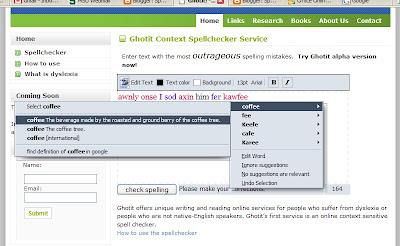
Now along comes Ghotit.com - the creation of an Israeli dyslexia activist (and now "inventor") named Ofer Chermesh. Ghotit - a play on the classic phonetic spelling of "fish" ("ghoti") [1] - is a web-based, context-centered, definitions included, spellcheck system aimed at dyslexics and English-language-learners.


Ghotit's "Alpha" trial - now online - suggests that you enter text with the most outrageous spelling mistakes. I'm not sure I tried the most outrageous. Instead I selected a sentence made up of a few student-mispelled words from this past year. I typed the following "sentence" into Ghotit, three different Google applications, and Microsoft Word.

awnly onse I sod axin him fer kawfee

in Ghotit I was offered the correct words for
awnly - only
onse - once
axin - asking
fer - for
kawfee - coffee
it did not offer me what I needed for "sod" - a "north Dublin" or "upper New England" version of "said" - but this was much better than the alternatives

in Google (G-mail and Blogspot) no correct corrections were offered - though in Google Docs I did get "only" and "once."

In Microsoft Word I only was offered correct choices for "onse" and "fer."

Yes, the difference with Ghotit is dramatic. The correct spellings are there. Even better, they are there and supported by definitions so it is easier to pick between "once" and "nose" when you click on "onse."

But yes, you'll still have to teach. You'll still have to help dyslexic students find the right spellings, and probably help them read the definitions (how great would this be if a text-to-speech engine could read the definitions?). And yet, this is potentially a huge independence tool and a huge frustration-reducer.


The folks at Ghotit would really like you to test the system out - and to test it out with real students - and to send them feedback. It's a great start, and it will get better the more you help. So bring your students to Ghotit today - and pronounce it "fished" [2] if you want.

-Ira Socol

In Ghotit's own words -


English spelling is not easy and is full of many spelling irregularities. The word GHOTI is a constructed example word used to illustrate these irregularities, since the official pronunciation of the word is counter-intuitive and is pronounced like the word “fish”.

Ghotit was founded by people that suffer from dyslexia. Ghotit’s mission is to improve the overall quality of life of a dyslectic. Ghotit is not a treatment for dyslexia. It's a set of services that assists dyslectics to overcome their writing and reading difficulties by helping the dyslectic to convert his poorly spelled written limitations to mainstream English.

Dyslexics are heavy users of spell checkers. However, standard spell and grammar checkers address the needs of the general population, who demonstrates average spelling and whose spelling mistakes are typing errors resulting in a spelling that shows high resemblance to the requested word. These spell checkers produce low results for users who demonstrate poor English spelling such as dyslectics, due to:
  • The written word spelling is ‘too far’ from the correct spelling
  • No support for misused/out-of-context words- the written word is a real-word that is spelled correctly but is used in the wrong context; for example: let’s meat later
  • No assistance provided to the user in selecting the correct candidate word

Focusing on the problems listed above, the Ghotit team has developed unique spellchecking and spellcorrecting algorithms which are at the core of the services Ghotit is developing for the dyslexic community.

[1] Ghoti is a constructed example used to illustrate irregularities in English spelling. It is a respelling of the word fish, and like it is pronounced /ˈfɪʃ/. It has,

  • gh, pronounced /f/ as in laugh /læf/;
  • o, pronounced /ɪ/ as in women /ˈwɪmɪn/; and
  • ti, pronounced /ʃ/ as in nation /ˈneɪʃən/. - from Wikipedia
[2] With the last t in "ghotit" pronounced the "North American Way" - that is, as an "almost" d - "ghotit" is pronounced "fished"

The Drool Room by Ira David Socol, a novel in stories that has - as at least one focus - life within "Special Education in America" - is now available from the River Foyle Press through lulu.com

US $16.00 on Amazon

US $16.00 direct via lulu.com

Look Inside This Book