Showing posts with label jfk. Show all posts

24 November 2013

Wiping Yourself Out of History

Yes, I am old enough to remember the assassination of John Fitzgerald Kennedy. And yes, as with almost anyone who remembers that day I believe that remembering the event matters a great deal.

With that in mind, I joined in the creation of a Kennedy Assassination Resource Site for our schools, as we begin the modeling of how to collect digital resources, and as the 50th Anniversary of that Friday in Dallas approached.

But we had one recurring problem. We kept trying to link two critical YouTube video clips to the site: one of the interruption of the soap opera As the World Turns for the first CBS News bulletin, the other, legendary CBS News anchor Walter Cronkite wiping away tears as he confirmed the news of the President's death. Now, I saw neither of these "live." I was in school when, probably, both happened, and we were an "NBC News family" anyway, pretty firmly committed to getting our news from Chet Huntley and David Brinkley. And yet, in national memory, those CBS clips have prettu much defined getting that awful news that day.

Walter Cronkite breaks the news to America,
November 22, 1963
"Three-quarters of the people in this country today are not old enough to remember the tragedy, but Baby Boomers forever will recite where they were and what they were doing when they got the news from Walter Cronkite," said the Boston Globe in an article about the National Football League's bizarre decision to play football games that weekend in 1963. CBS was the top rated television network (there were only three then), and CBS News was the most watched news source in the nation. Cronkite was so powerful that he is largely credited, five years later, with turning the majority of Americans against the Vietnam War.

So, we figured Cronkite and CBS were important parts of the story of that awful weekend. But CBS thought differently. Every time we tried to link to either of these videos the links would vanish, taken down because of "copyright claims by CBS," so eventually we gave up. What our students see is instead, my family's preference, NBC News. NBC (and ABC) aggressively embracing YouTube sharing.

 NBC News, November 22, 1963

Now eventually, on Sunday morning, November 24, 2013, CBS did post a contemporarily-edited version from CBS Sunday Morning to YouTube. But this is not the kind of source material we want our students to begin with. So CBS News and Cronkite are gone, and Huntley-Brinkley are in. In 20 years, if these policies remain the same, no one will write, "where they were and what they were doing when they got the news from Walter Cronkite," because Cronkite will have vanished from history, hidden from view by the CBS attitude toward copyright.

This is not just about the Kennedy assassination, of course. This is about the massive mistakes so many are making a decade or so after the Gutenberg Era ended.

"It is a sobering fact that some 90% of papers that have been published in academic journals are never cited. Indeed, as many as 50% of papers are never read by anyone other than their authors, referees and journal editors." notes an Indiana University researcher (PDF). To which my response is "duh." Hidden behind paywalls, limited to the research strategies of bored graduate students, it is clear that no one gives a damn about what you have written if you choose to severely limit your audience from the start.

My blog's statistical analysis suggests that more people have read my blog post - in one month - criticizing Dr. Richard Allington of the University of Tennessee at Knoxville than have probably read all the academic papers by all of Allington's grad students. My post being public, and their research being, not.
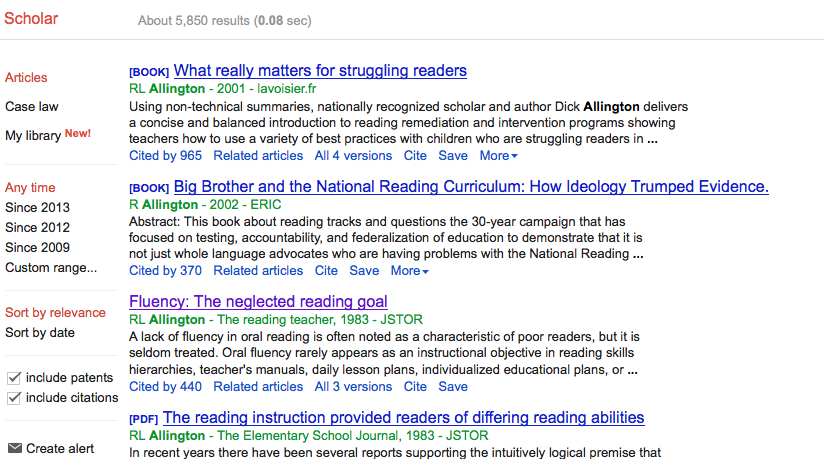

Closed for business: Allington's Google Scholar results list all sorts
of research that will cost you dearly in you want to read it.
Why is he choosing to avoid the national conversation?
In fact, if I use Google Scholar to search for Allington's work, I find links to $25 books and $15 journal articles, and I'm not paying for either, and neither are teachers. I don't know, maybe he assigns his books so his students have to buy them. If I use "regular" Google I find a few "light" pieces available, alongside many costly ink-on-paper books. Again, sorry, no thanks.

RIAA caught stealing copyrighted web code as they pursue
kids who download a song.
Do you want to be part of the conversation or not? That is the question. Many, university faculty, grad students, the Authors Guild, the MPAA, the RIAA, would rather not be. In pursuit of pennies, they are actually seeking irrelevance.

These groups all think they are benefitting their "members," but that's obviously not true. They are all choosing to drive their audiences away. It is not even a tough prediction to suggest that university attendance will nose-dive over the next 20 years, better information than many post-secondary courses offer is available free and in much more engaging forms... That "film" and music distribution will look completely different in five years: Straight to YouTube has become the path for many of our most creative new musicians and film makers... That authors will be publishing free but making money via contribution and performance in less than five years: Free stuff to read is all over the internet, and its a much better collection than you'll buy at your local Barnes&Noble. This is neither "good" nor "bad," it is just inevitable. The distribution system of the 20th Century makes no sense to most anymore. It was clumsy and expensive and enriched the wrong people anyway. The copyright system of the 20th Century makes no sense anymore - it really never did make sense to protect a cartoon mouse as "intellectual property" for ten times as long as a life-changing medication. It also enriched the wrong people - corporations and attorneys rather than inventive minds. So both will go away, and soon.

So, you have your choice. Hide behind paywalls and attack lawyers, or share your works with the world. Be part of the global conversation or confine your thoughts to an increasingly irrelevant elite.
Figure out how to live via a culture of sharing and communication or sit back and imagine royalty checks rolling in.

But realize that the sides are forming now. CBS may eliminate itself from the understood history of global journalism in pursuit of a few cents. Just as the RIAA killed the music CD by charging $14 instead of $3 for that format in 2000. Just as university faculties sit back proudly as their work in "peer reviewed" journals gathers dust and has zero impact on anyone. And if you choose the wrong side you might become the next AOL - remember? They had this brilliant business model...

- Ira Socol

08 July 2011

Why would any child listen to us?

This was a long, long time ago...


What happened in October 1929? Why were income taxes
very high in 1919? Your Republican member of Congress
does not know, but perhaps you should.
And this... "House Budget Committee Chairman Paul Ryan's bold entitlement reform plan goes beyond taming spending. It recognizes that the history of cutting taxes vindicates Calvin Coolidge, not Paul Krugman," is from "today," from an editorial in Investors' Business Daily, which illustrated their desire to roll back the clock over 80 years - complete with an entertaining graph which "conveniently" leaves off what happened seven months after President Calvin Coolidge left office.

But it is not this intellectual dishonesty behind the actions of America's Republicans that disturbs me. It is not just that they will not explain why the US top marginal income tax rate was so high in 1919, or that their preferred "strategy" produced a worldwide economic collapse that took a decade to begin to dig out of. Lying is one thing...

...being defeated is another.

If you watch the whole Kennedy speech from that day in Houston, you will hear honesty you have not heard from a leader in a very long time. "All this will cost us a great deal of money," he says, "a staggering sum." He details that, saying the cost of the space program will rise to be "more than 50 cents per person per week for every man, woman, and child in America." Yes, things that matter - even something which mattered spiritually more than perhaps anything else - cost money then. And will cost money now. But societies which care about the future do what matters.

Societies which don't, don't. And, in Washington DC, in Westminster in London, in Ottawa, Canada, in Canberra, Australia, we are usually listing what we cannot do. We plan our defeats before we even let ourselves discuss our possibilities.

In the United States we cannot provide everyone with decent health care, we cannot properly fund public education or the preparation of teachers. We cannot rebuild New Orleans, we cannot create national rail travel options. We cannot even make our bridges safe, or, according to Michigan's governor, make cars which get good gas mileage. Now, 49 years after Kennedy's speech, we cannot even get a human into space.

It's not so different in the United Kingdom. David Cameron's government can't feed or house its own people - something even World War II Britain managed to do. They can't pay for decent schools either, and after doing it for 66 years, they're not sure they can provide universal health care anymore.

In Canada the Prime Minister couldn't even figure out how to stay in office without shutting down Parliament like a third rate military dictator, then gets re-elected by claiming that Canada really can't do anything anymore.


Heroism is a real thing, and we need heroes today
(The PT 109 Story from Navy Log, a 1950s TV show)

Heroism is a real thing. John Kennedy had many leadership skills, including, obviously, the gift of human communication, but he - and much of his generation - also had an understanding that the future needed to be a better place, and that creating that better place would take hard work and sacrifice.

The leaders who built the "postwar" world were risk-takers because they understood the risk of not moving forward. Whether Kennedy in the United States, or Willy Brandt in Germany, or Robert Schuman of France, they were heroes before they ran for political office, they understood real risk and reward, and they all understood the value of society and community.

Before The Great Society, Robert Kennedy sees
"Poverty in the United States
"
And so John Fitzgerald Kennedy not only pushed America to the moon, he began an 8-year administration which attempted to create a nation with civil rights for all, a nation which would "wipe out" poverty (and despite what you've heard, that worked so well that ever since Republicans have been claiming that America's poor aren't really poor), which would eliminate the disaster that was then senior health care, and which helped create the real "jet age" through support for huge planes which made flight affordable.

In Berlin Willy Brandt took a destroyed, divided city and rebuilt it into one of world's great symbols of democracy, and then took huge risks to breach the Iron Curtain with friendship.

And in France, Robert Schuman, escaped prisoner of the Gestapo, began the most audacious experiment in Europe since the dawn of Rome, when he set in motion the effort to build a peaceful, democratic, united continent which welcomed the just defeated Germany as an equal partner.

See, those are actual risk-taking activities. Those attempts are not the same as finding "grand bargains" or yelling at a crumbling wall, or babbling about "big societies." They were real.

And obviously those were real attempts to create an improved future - not the hysterical whining of those who think a time of incredible oppression of minorities and women, combined with high infant mortality and starving farmers, represents "the good old days."

It is hard to even imagine JFK's "Moon Speech" in today's America. In a nation where clowns claim to be in a "Tea Party" recovering some supposed "anti-tax" past (quick question, were the original "Tea Party" rioters opposed to paying taxes, or, did they want representation in the British Parliament?), in a country where the Secretary of Education, the man charged with safeguarding the future, is constantly telling us what we cannot do, in a nation where people vote like they fully believe their greatness is in the past. It is hard to imagine what our students might say if they watched the whole speech. Or if British students actually listened to Churchill, or if Canadian students thought about John Macdonald trying to pull a bizarre collection of British colonies together with an impossible railroad...

What would they say?

And what would they say about us, the collective "we" who have lost our imagination and our ambition. "We" who ask about everything, "what will it cost me?" "We" who choose to not even invest in our own children?


Will they expect us to be - just a little - heroic? To take real risks? To try big things? To make sacrifices for something we may not live to see?

I hope so.

- Ira Socol