Showing posts with label kipp. Show all posts

10 December 2013

Paul Tough v. Peter Høeg - or - the Advantages and Limits of "Research"

or, How Children Succeed v. Borderliners

Years ago now, in the first semester of my doctoral program, a professor named Cleo Cherryholmes
In Memorian Cleo H. Cherryholmes
challenger of all that we "know"
came to speak to my "Research Methods" class. Cleo would later become a remarkable mentor, and a friend, but at that moment all I knew was that he was being brought into this class as a sop to postmodernism and qualitative research, things dismissed by the demeaning faculty leading the course, led by Dr. Robert Floden.

About 20 minutes into Cleo's discussion, I interrupted and asked, "but isn't it all just storytelling?" And he said, "Obviously, but how do you know that?" "And I said, "I'm not sure, I just know it."

And he said, "Oh, good," and paused for maximum effect, "because if you had gotten this from him," he looked at Floden, "I'd have to think a lot more of him than I do."

We became fast friends. Cleo would mean much to me, and he continues to inform what I do and how I see. Floden would become, in my world view of education, one of the leading villains - preventing universities from becoming useful to K-12 education. But that is not this story...

This story is encompassed in my question: "[the writing of research, the conduct of research] isn't it all just storytelling?"

I've thought about this question a great deal the last couple of weeks as I've struggled through listening to Paul Tough's book, How Children Succeed: Grit, Curiosity, and the Hidden Power of Character. It is a very good book, a very important book, and yet, well, something very essential is missing from Tough's reporting, something which ultimately makes the book as dangerous as it is valuable. What's missing isn't just that Tough never learned the "art of the anecdote" from those who led the New Journalism revolution 50 years ago - his "human" scenes fall flat every time - and it isn't just that a career at The New York Times tends to make most who live that life fawn in the presence of power, whether Scooter Libby or the Goldman-Sachs Education Man, Geoffrey Canada.

It is more than either of those things, it is, I suspect, the essential failure of straight rationalism, and of those who always seek causal inference. And it is that straight rationalism and a direct belief in causal inference - combined with the very limited world view constructed from life in elite schools, elite jobs, and elite neighborhoods - surely creates its own palette of disorders: Perhaps this is a case of Data Over Acceptance Disorder, the problem of seeing the world purely through quantitative data analysis, combined with Elite Limited Vision Disorder, the belief that the world you know is the only world that matters. And if these are the disorders which limit and ultimately undo Tough's storytelling it is because not only the author suffers from these issues, but almost every adult interviewed in the book suffers from the same - from the unprepared Chicago High School principal to the founder of KIPP, from the University of Chicago economists who open Tough's tale to the pop psychologists who construct theories about "learned optimism."

As I said, it's an important book. As Tough told Valerie Strauss, "The book is about two things: first, an emerging body of research that shows the importance of so-called non-cognitive skills in children’s success; and second, a new set of experimental interventions that are trying to use that research to help improve outcomes for children, especially children growing up in disadvantage. Some of this research is decades old; some is very new. Part of what I’m trying to do in the book is to show the connections between fields of research that are generally kept quite separate, including various branches of economics, neuroscience, pediatrics, and psychology." It is an important debunking of much of the so-called "research" behind the work of 35 years of "educational reformers," going back to the start of the Reagan Administration. It is, though Tough doesn't know this, a vindication of sorts for the Open Classroom movement of the 1960s and 1970s, the Schools Without Walls movement of the same period, of high schools like the Philadelphia Parkway Program and New Rochelle's (NY) 3Is which worked to help "troubled" kids via reconstruction of self through independence and trust. (Tough doesn't understand what "character education" may look like, but those with a wider understanding of educational history will see this clearly.)

And its an important book because of its investigation of Allostatic Load and what that concept requires of educators. All this is good, and all of that offsets Tough's depressing unquestioning trust in the powerful, from the University of Chicago to Arne Duncan, from Harvard researchers to those who run elite schools to those elites who run schools for those in poverty. That Tough never asks the questions beneath his questions is no more reason not to read his book than it is not to read The New York Times. We can use both to collect information while reserving the right to do better analysis than the author - or publication - may be capable of.

The founder of KIPP went to school
beyond these gates, paying a tuition
now at $37,000+ per year:
a place with none of the rules
enforced on KIPP students.
Mostly, it's an important book because Tough has written a book which might begin to persuade his The New York Times social class, the wealthy, powerful people who set national and international agendas, that their education agenda of the past 30 years has been wrong. I cannot do that, and my writing cannot do that, because "evidence" of a single specific form is the only thing which this group responds to. And Paul Tough has assembled that form of information admirably, largely repudiating all that he has - and much of what The New York Times has - written about education before. That switch really matters.

But it is a dangerous book because Tough continues to look for simple answers which will make life comfortable for his social class. It is a dangerous book because it never really asks the tough questions. It is a dangerous book because it holds out those old New England Calvinist ideals - grit and hard work - as the "by your own bootstraps" way to the top - as the path for the poor without ever really acknowledging that the rich need none of that.

Principally it is a dangerous book because, through the use of only stories selected by the researchers Tough fawns over, it implies a series of essential untruths about those who grow up along America's socio-economic, learning, and behavioral borderlines. It is not a dangerous book, however, for the reasons suggested by "the usual suspects" - E.D. Hirsch, Daniel Willingham, and Peter Meyer. "Yet it is hard to argue from recent reform efforts that the aim has been to increase the “information we can stuff into her brain in the first few years," Hirsch laughably pronounces, proving once again that he has actually never seen a public school. The danger in the book is not Tough's correct demolition of the "cognitive hypothesis" - the idea that schools have been focusing on Googlable information instead of life long learning competencies - but his lack of art in understanding children born differently from himself.

But that missing art, that missing empathy, that missing doubt, where do we go to reach for that? And why is that important?

'640K is more memory than anyone will ever need.'

The first computer mouse: research must have shown
that taking your right hand off the keyboard
would make one less efficient
Whether Bill Gates ever actually said, "640K is more memory than anyone will ever need," isn't the important question. The fact is that the computer industry, like most industries, is filled with examples of research data leading to flawed conclusions because the research is - as quantifiable research always is - based on understandings of the past.

The graphical user interface, the computer mouse, was known to all sorts of people before Apple Computer introduced the Lisa Computer in 1983. In fact, it was a gift to Steve Jobs from Xerox, which couldn't see any advantage in it. And there is no doubt that, based in the knowledge of computer users in the early 1980s, research must have shown that taking your right hand off the keyboard would make one less efficient. The research only shows the known world of the researcher.

Twenty years later, among a dozen companies, only Steve Jobs' people understood what a handheld could do. Others were trying to build better phones. But the iPhone was a pretty crappy phone that did a dozen non-phone things really well. Ford, in the late 1950s, named a new car the "Edsel," a name which meant sophistication and fine design in southeast Michigan, but which just sounded funny to everyone else. Blackberry missed the point that phones, even sophisticated phones in the hands of business leaders, were now "mobiles," which needed to function as effective computers.

That fact: that quantifiable research can only tell you about what you already know, is a critical problem for people of Paul Tough's class, people with Data Over Acceptance Disorder. And its a disaster in education - blocking real change from ever being considered "What Works" by those in power. And so we get someone like David Coleman, "architect of the Common Core," making this ridiculous - if entertainingly profane - statement:
"Do you know the two most popular forms of writing in the American high school today?…It is either the exposition of a personal opinion or the presentation of a personal matter. The only problem, forgive me for saying this so bluntly, the only problem with these two forms of writing is as you grow up in this world you realize people don’t really give a sh** about what you feel or think. What they instead care about is can you make an argument with evidence, is there something verifiable behind what you’re saying or what you think or feel that you can demonstrate to me. It is a rare working environment that someone says, “Johnson, I need a market analysis by Friday but before that I need a compelling account of your childhood.”
Coleman, a life spent fully immersed in nothing but prior knowledge, cannot understand the power of either personal experience or the imagination. He believes that the best storytelling is that which is endlessly repeated until it is "normed." But the best storytelling is not what Paul Tough writes, or what David Coleman tests - rather - it begins with the art of seeing what few others can.

Thus, in Tough's chapters 11 and 12, his researchers search their known world among children they do not know at all - and that is a problem for the story Tough wants to tell. First, he tells us that kids in a Chicago juvenile detention facility have much smaller vocabularies than other students, but we have no way of knowing whether that is true or not. The vocabularies of the jailed teens was not measured, instead they were asked about white middle class vocabulary. I could easily devise a test based on South Side Chicago street vocabulary that middle class AP students would fail, but there just isn't any validity in either assessment. Then Tough writes about how children with less "attentive" mothers were more likely to engage in disruptive activities in classrooms - but again - we do not have any idea what "disruption" means in this context. We might guess the behavior standard being sought is that used by KIPP, sitting still, staring straight ahead, and shutting up. But if I looked at St. Ann's School in Brooklyn Heights, I might find that the wealthy children of highly attentive parents would be acting a lot like Tough's troubled kids - a great deal of movement, distraction, talking out of turn, leaving the classroom, staring out the window... In fact, later in the book, Tough himself acknowledges as much, but that pesky Data Over Acceptance Disorder prevents him from understanding his own experience, he's stuck in David Coleman's world of non-imagination.

from the borderline...

Now, as I have struggled with Tough's clinical prose, I have found my mind inserting the voice of the young Peter in Peter Høeg's Borderliners. A unique voice. A literary voice. And, for Mr. Coleman, a "compelling account of [someone's] childhood."

Borderliners, in many ways what I consider the most important book available about education, is all about allostatic load, but it also understands that high allostatic load factors do not mean that a child comes to school "disadvantaged." Rather, their advantages are simply not respected nor exploited by the school. The damaged children described by the "young Peter's" narration are all brilliant, all incredible observers of their worlds, and are all incredibly capable. They sound - in Høeg's storytelling - quite unlike the way any of Tough's children "sound." And perhaps this is because Høeg can do something none of Tough's numbers and none of the researcher/storytellers in How Children Succeed can do - that is, use one's own unique observational skills to channel the actual voices of these children.

And this is what matters about actually hearing, and actually relaying to us, the voices of these children - the voices that Høeg channels explain why Tough, and KIPP founder Dave Levin, can't figure out why their plans don't really work. And the central difference between Tough's story and Høeg's story is this - because of Elite Limited Vision Disorder Tough and his friends begin from the point of view of what these kids cannot do. Høeg, on the other hand, starts with everything his three - or four - heroes can do.

And that makes all the difference in the world. Tough and friends want to teach "grit" to the "grittiest" kids in America, because none of them has any idea who these kids are.

Actually, what Tough and his friends want these kids to possess is willing compliance, not "grit" nor "character." "Grit" and "character," I have found in a lifetime of working with kids on that "borderline" Høeg talks about, is what has enabled the kids Tough wants to "help" to survive - even to age five or six.

Høeg, understands the gap created by allostatic load, and that it is not a gap of achievement or character, but a gap of inexactness as opposed to exactness...
"Fredhoj and Biehl never said it straight out, but I know now, with certainty, what they were thinking. Or maybe not thinking, but sensing. What the cosmology was, upon which all of their actions rested. They were thinking that in the beginning God created heaven and earth as raw material, like a group of pupils entering Primary One, designated and earmarked for processing and ennoblement. As the straight path along which the process of evolution should progress, he created linear time. And as an instrument for measuring how far the process of evolution had advanced, he created mathematics and physics.

"I have had the following thought: What if God were not a math­ematician? What if he had been working, like Katarina and August and me, without actually having defined either questions or answers? And what if his result had not been exact but approximate? An approximate balance perhaps. Not something that had to be improved upon, a springboard to further achievement, but some­thing that was already more or less complete and in equilibrium." - Høeg Borderliners
"What if God were not a math­ematician?" and not a quantitative researcher? What if God was a storyteller, and education could build on, and not fight against, the stories our children bring to us? What if our researchers understood the art of listening to real stories and the art of retelling those stories? What if those charged with discovering "what works" for children actually knew how to hear and see children?
"I don’t think the specific character strengths that KIPP and Riverdale have chosen are necessarily the right ones. In fact, I don’t think we’ll ever have an authoritative list of essential character strengths. And I do think that for any young person, part of the process of growing up is coming to understand your own character. But I think there is some strong evidence emerging about how effective certain character strengths are in helping guide young people toward successful outcomes. For me, that list includes grit, conscientiousness, optimism, self-control and perseverance. That’s not a prescriptive checklist, but it’s a useful guide for anyone, young or old." - Tough in interview
"Not something that had to be improved upon, a springboard to further achievement, but some­thing that was already more or less complete and in equilibrium." Here's where the limitations of what we call "research" appear. Here's where those limitations become, umm, most limiting. Where Tough can only measure accomplishment by children who are "improved" - better grades, more success in interactions with the kind of people Arne Duncan and Barack Obama put in charge, Høeg understands, and can explain, something very different.

Though the narrator of Høeg's book uses the term "damaged" for himself and his two - or is it three? - comrades, he never doubts any of their capabilities, or their abilities to out-think and outmaneuver all those not "on the borderline." They are not deficient and they are not disadvantaged, despite their pain, despite wounds beyond most of our comprehension. And they are surely not "behind," unless you rig the measurement system, or, as Tough does, you assume that the rigged measurement system is both fair and reasonable.

Now I don't really know if it is reasonable - neither does Høeg, nor do any of us who lie outside the meaty part of the curve - but we all know that it is not fair. We all know that the problem is transactional, not ours alone. We all know, for example, that if homework wasn't assigned we wouldn't be in trouble for not doing homework. That if sitting in chairs was not required we wouldn't be in trouble for not sitting still in chairs. That if work was read to us, those of us who struggle with alphabetic decoding wouldn't be considered "retards." That if we could set our own school hours we wouldn't be in trouble for being late or truant so often. Even, if preventative health care and good birth control was free, available, and respected within society, we might not get women/get pregnant so often. And that if our economic system was remotely fair, we might commit fewer crimes. Yes. All of this is true. And all of it storms through Høeg's storytelling, and none of it appears in Tough's.

Which is what makes Tough's work, like all modernist, rationalist, discourse, just part of what we need to know, it is a story, of course. It is the story the author wishes to tell, like all stories. It is a story the author believes in and which rises out of his/her construction of his/her experience, like all stories, but it fails to get to the human part of the experience, the essential truths, like so much research and too much "non-fiction."

You see, you simply cannot, using numbers, using "evidence," or even using the University of Chicago School of Economics, write the paragraphs below, which are an absolutely required frame for reading Tough's analysis:
"When you assess something, you are forced to assume that a linear scale of values can be applied to it. Otherwise no assessment is possible. Every person who says of something that it is good or bad or a bit better than yesterday is declaring that a points system exists; that you can, in a reasonably clear and obvious fashion, set some sort of a number against an achievement.

"But never at any time has a code of practice been laid down for the awarding of points. No offense intended to anyone. Never at any time in the history of the world has anyone-for anything ever so slightly more complicated than the straightforward play of a ball or a 400-meter race-been able to come up with a code of practice that could be learned and followed by several different people, in such a way that they would all arrive at the same mark. Never at any time have they been able to agree on a method for determining when one drawing, one meal, one sentence, one insult, the picking of one lock, one blow, one patriotic song, one Danish essay, one playground, one frog, or one interview is good or bad or better or worse than another."
- Peter Høeg Borderliners
The paragraphs above, if they framed Tough's story, would transform it, as would these:
"At Biehl's you had to sit down for five to six hours every day ­not including the study period-five days a week plus Sunday for the boarders, more than forty weeks a year, for ten years. While constantly having to strive to be precise and accurate, in order to improve.

"I believe that this went against the nature of children."
- Peter Høeg Borderliners
For Høeg's words challenge the world Tough assumes. Høeg's story inserts the doubt and variability into Tough's world of science and measurement. And, in the end, Høeg's story explains what these kids need in a way Tough cannot.

There is this scene in Borderliners, in it the young narrator Peter describes exactly what he needs. He
tells the story of the orphanage he was in, and how you only got 30 seconds of hot water in the shower, and then had to move to the cold shower. But his friend Oscar Humlum stays under the cold for minutes, stopping the line, leaving Peter in the comfort of the hot water stream. Humlum says nothing then, needs to say nothing, offers neither praise nor sympathy. Rather, he just gives a moment of peace, and for Peter, this is mythic.

Because that is what "we" need, Mr. Tough. That is what we've always needed. Acceptance, belief, a few moments of peace, and maybe - evidence that "we" are worth sacrificing for. Not the kind of "work sacrifice" KIPP expects from their teachers, not the paid sacrifice of social workers, not even the charity sacrifice of volunteers, but the kind of deep personal sacrifice which suggests real care.

It is that which will give "us" both a chance to breathe and believe in ourselves. And in that pause we may find a path.

Will that make us into perfect adults by the standards of a New York Times writer or a Riverdale Country School graduate? Probably not. Both Tough and KIPP are quick to label a Bronx kid with steady work at high level customer service call centers as a "failure" because he didn't complete four years of college. They've not only labeled him, they've convinced the 20-something himself of that failure. You understand, colonialists like KIPP want to make sure the powerless never really feel empowered, so "not quite getting there" is their ultimate currency. But maybe, just maybe, it will allow "us" to be a little bit more alright, and maybe a little bit safer in our own skin.

That won't be enough for Paul Tough, because he can't hear the story, because he has never learned to hear or to tell the complex stories of humanity, but it should be enough for most of us.

"That was what we meant by science. That both question and answer are tied up with uncertainty, and that they are painful. But that there is no way round them. And that one hides nothing; instead everything is brought out into the open." - Peter Høeg Borderliners

- Ira Socol

09 December 2011

Among Schoolchildren - December 2011

Learning how to work on any device, anywhere
Monticello High School Library
Charlottesville, Virginia
I have spent another week in Albemarle County, Virginia, working with the people, of all ages, who make up the Albemarle County Public Schools. There are fabulous educators there, people who work every day to get better at what they do. People who seem to spend 24/7 reaching out across the globe to bring their students better learning opportunities, better connections, more far reaching experiences. But now I want to talk about the kids.

There are myths in America that our kids are, well, I don't know, "lazy," "uneducated," that they are "failing," that, to use US Secretary of Education Arne Duncan's words - just this week - that we are in "a race to the bottom." And believe me, I know our schools are a long way from perfect. The educators in Albemarle County know that their schools are a long way from perfect, and we are putting in some incredibly long days to try and get closer. That is what I joined them in for the past ten, very, very long days, but...

The last five days I worked with students, as I helped teachers re-imagine lessons. We're working on something called "The Iridescent Classroom" in Albemarle County, a form of Universal Design for Learning joined to a deep commitment to getting kids ready for the choices of their century, the choices of their generation, so that they have the skills, the passions, and the knowledge to do a better job than previous generations. This requires, for students who will, for the most part, begin their adulthood in the third decade of the Twenty-First Century, the ability to collaborate globally, to share transparently, to value all cultures and skills, to search rapidly and effectively, to choose tools wisely, and to do a lot more than read and comprehend, but to be constantly able to adapt knowledge to changing environments and situations. It also includes the ability to work anywhere (like an airport, as I am doing now), from many devices, with every kind of person, through every kind of interface. And it means thinking deeply, in transformative ways.

For, to quote one sixth grader this week, "People keep making the same mistakes over and over again, and we have to stop."

He said that in a lesson about the Andersonville Trial. They are starting to study the Civil War and they are beginning Middle School, and I thought a lesson bringing these things together might make sense. Now I don't know what you were asked to do at 12, but I wasn't asked to wrestle with one of the thorniest questions of national morality... when is a person obligated to disobey orders, to rebel against his government.


We started by watching the scene above, representing a crucial moment in United States history, in which the United States Government declares that even a military officer has an obligation to disobey orders, to take up arms against his government. A position the U.S. reiterated (with the death penalty) at Nuremberg, and reiterated again when My Lai occurred.We started them with these websites:

And we asked these 12-year-olds, not rich kids, not kids from great neighborhoods, not kids whose parents have university degrees, but kids from some incredibly poor places, kids who came from an elementary school where teachers join local churches in sending food home every weekend when kids will be away from free school lunches, the kinds of kids Arne Duncan thinks can only handle KIPP education so they learn to stare at their teachers, we asked them what they thought... and it was remarkable.

They understood all the implications, the difficulties, the issues - ranging from a crowd of kids bullying someone to nations invading nations. They looked stuff up on their laptops, they raised serious questions. They even challenged the adults in the room.

This is what education means to me. It may or may not matter much if these kids are slow readers, we can get them information many ways. It may or may not matter if they spell well, when I was asked, "how do you spell that?" I simply said, "I'm really not sure, try spelling it in Google and see what happens." They did, it worked, they found what they needed. But what these kids already have are deep inquiry skills, deep comprehension skills, and effective technology skills. And you know what? That other stuff, well, its not easy, but they live in a century when all that is solvable.

In a math lesson a day later I watched a seventh grader, a kid who really struggled to divide 64 by 2 in his head, or 32 by 2, or, for that matter, 16 by 2, work diligently to explain to his disbelieving teacher how he knew - and he knew instantly - how many games are in the NCAA basketball tournament. He knew, because math is about rules and logic, and his logic was perfect and his understanding of the rules I had described was perfect, and because math is not arithmetic, no matter how much our poorly educated national and state leaders think it is. He and his classmates also understood, almost instantly, that the question - no calculators or paper or Google allowed - "If the temperature in Detroit, Michigan is 50 degrees what is the temperature likely to be in Windsor, Ontario? was about (a) culture, and then (b) understanding comparable scales, and then (c) order of operations.

Yes, I showed them this map. Yes they were surprised that Michigan is north of Canada (as you may be). But they got it, and could do it in their head, and understood that if you divide by 2 first then subtract 32, you're in trouble, they even understood that when they said "9" and a teacher said, "well actually 9.9," that it didn't matter, the point of mental math is to know that if someone anywhere outside the U.S. says, "it's 10 degrees," that the person isn't very cold.


With other sixth graders we rocked through a Yuri Gargarin lesson, heading deep into what "space" means and ideas of distance. I met one of the fastest, most effective, users of a search engine I have ever met... a kid usually labeled, "a problem."

I watched fourth graders listen to a story while using computers to look up everything they didn't understand.We were reading Titanicatand we were flooding them with ideas. We used Google Maps to fly from Esmont, Virginia to Belfast. Belfast? They all found Belfast. What country is Belfast in? What does "UK" mean? OK, does, "University of Kentucky" make sense? What is the United Kingdom? Is it in England or is England in the UK? Where in Belfast was the ship built? Do they still build ships there?

The story moves to Southampton, and on the big white board we showed them the Quay at Southampton. They found that. Where was London? "Who else sailed from London that we talk about in Virginia?" OK, they got me there, they knew the name of the ship and the captain who brought the colonists to Jamestown in 1607, something I didn't.

It was a wildly chaotic environment... and yet... it was not. The kids were all working, really working, learning search, learning maps. If some found their houses or ended up looking at London or missed half the story, its no big deal. They'll read the book later. They were learning skills and doing things many of the people who write the laws about education probably cannot do. Mostly, they were reveling in inquiry.

I ended the week in a high school, talking to seniors who wanted to ask questions for a citizenship/service capstone project. We sat in a library filled with students working in all sorts of ways with all sorts of tools, and they asked what I thought about requiring all Americans to have health insurance and offering in state tuition to "illegal" - undocumented - immigrants who live in the state.

I challenged them to stop thinking politically, or even constitutionally (which is, by nature, open to varied interpretations), and to think about what kind of society they wanted to live in. Why do we have laws? Why do we require anyone to do anything? Why can they tell you not to drive 100 miles an hour or tell you to wear a seat belt? The kid working on the tuition issue, who is putting together a public forum with elected officials and experts, and who invited "Rick Perry, because, why not?" asked what I thought. I suggested first that he think back to 1607 and Jamestown, Virginia. Weren't those illegal immigrants? Didn't they come without permission, not knowing the language, not willing to learn the language or rules of the society? Weren't they sloppy people so uninterested in health that they began a pandemic? Maybe, I suggested, the otherwise conservative Texas Governor Perry believes in this because Texas too was created by illegal immigrants from the United States?

They rolled with all this, wonderfully neither accepting my opinion nor rejecting it. They were considering, wondering what to ask next, who to ask next. They were as smart, as educated, as engaged as any 18-year-olds I have ever met.

So I brought up the idea of "equal vs. equitable" to them.I asked if Finland's income-based system of fines sounded good to them. This is a tough concept for Americans to consider, and they immediately began debating it. I should have brought up the pilot of The Andy Griffith Show, which, back in 1960, was all about that...
"Danny finally agrees with his wife and decides to the $5 fine. He takes out a huge wad of cash, and he gives him more money and more money. Danny doesn't care if Andy is robbing him, after all he's a big time star. Andy sees this as a time to get more money, and tells Danny he has to pay $100 or spend 10 days in jail. meanwhile Any fines another motorist $2 for the same offense.
 

"Danny is furious! He goes in his jail cell talks about tyranny in this world, and how he languishes in a cold, damp, dirty cell. Andy is offended by this and says "Now hold on a durn second!" Andy says his Aunt Lucy cleans the cell and does a fine job! The host then cross-examines Andy, and Andy says he had to raise the price to make an impression on these city folk, who can get $5 or $10 very easily. Danny realizes he was wrong and apologizes to Andy in the end after hearing his explanation"
but... I now know these kids, and I suspect one of them will find that, and a whole lot more.

So I just want to tell you, that the kids are all right, and if we trust them, and challenge them, and stop sweating the meaningless stuff every day, they'll be great. They'll be a lot better than we ever were.

- Ira Socol

15 October 2010

A Tragedy, indeed.

"In the tiny high school of the zone’s Promise Academy I, which teaches 66 sophomores and 65 juniors (it grows by one grade per year), the average class size is under 15, generally with two licensed teachers in every room. There are three student advocates to provide guidance and advice, as well as a social worker, a guidance counselor and a college counselor, and one-on-one tutoring after school.

"The school, which opened in 2004 in a gleaming new building on 125th Street, should have had a senior class by now, but the batch of students that started then, as sixth graders, was dismissed by the board en masse before reaching the ninth grade after it judged the students’ performance too weak to found a high school on. Mr. Canada called the dismissal “a tragedy.”' - The New York Times, 12 October 2010
I want you to think about this quote from an article on the Billionaire Boys' Club's "Superman," Geoffrey Canada and his much "lauded" Harlem Children's Zone schools.

"...but the batch of students that started then, as sixth graders, was dismissed by the board en masse before reaching the ninth grade after it judged the students’ performance too weak to found a high school on." How lovely.

Superman just left Jimmy Olsen out there to die, and he says, "hey, it's a tragedy."


"We start with children from birth and stay with them until they graduate," unless their test scores might embarrass you and your Wall Street donors. Yes, that's the alternative to public education we are being offered.

Now, I like much of what the Harlem Children's Zone represents. I like the Euro Socialist vision for America. Big corporations and the very rich should re-distribute large amounts of their obscene wealth to those born without silver spoons. Americans should have a right to affordable health care, no matter what their income level. U.S. parents should get support from birth as parents in France, Denmark, Germany, and Finland do.

I agree with Canada, the solution to education lies in solving the problems of poverty, not the reverse.

But Canada's education model is less impressive. Despite having a teacher for every 8 students, despite massive funding, his students tend to do - on average - a little bit better than kids in some of the most poorly supported public schools in New York City.

Like Teach for America and KIPP he makes rich people feel good, expends a lot of cash, and still has to set the bar incredibly low in order to show any results at all. [According to KIPP's favorite study, about 10% of KIPP schools show significant improvement after 4 years when compared to America's worst schools. According to TFA's favorite study (oddly by the same research group) TFA teachers were a tiny bit better than completely unprepared, untrained novice teachers - if you don't count English Language Learners or Special Education students.]

But the trick to all - the politically aggressive part of the charter school movement, the Harlem Children's Zone, KIPP, TFA, Democrats for Education Reform, is student selectivity, and the ability to dump kids - as Canada did - who fail to measure up.

Which is not what public educators do.

In a fight with KIPP Press Agent Jay Mathews a month or so ago I mentioned the Godfrey-Lee Public Schools near Grand Rapids, MI. Godfrey-Lee has real demographic problems - very low parental income, very low parental English proficiency, very low parental education, the lowest property tax base in the state. And Godfrey-Lee gets no massive funding support from Goldman-Sachs and others. So students may struggle, and the Middle School might get declared to be "in need of improvement." But what Godfrey-Lee does not do is toss out kids who struggle.

Godfrey-Lee doesn't do it. Nor do thousands and thousands of public school districts with similar demographics across America. They open their doors to every child who walks in. No complex parent application process. No publicly humiliating lottery. No "we're full" signs. No conversations about how "a student with these kinds of issues might be better in a public school." No limits on transportation services. Just a door which opens and stays open, for some students until they are 25.

This is what separates real educators from the "school reformers." Public educators don't kick out a grade because the kids might make you look bad. Public educators don't discourage special ed kids. Public educators don't fail to provide transportation. Public educators don't pick and choose their results.

Educating all children is hard. But the solution does not lie in the Geoffrey Canada model, the KIPP model, the charter model. The solution lies in child-centered education, and in reforming our national priorities, so we become a nation where every child matters.

- Ira Socol

03 September 2010

On KIPP, and the question, does philosophy matter?

Sometimes the field of battle expands. That's OK, right? Those of us who gather on Twitter or via Blogs or in the corners of conferences always talk about being more aggressive at getting the ideas of real educational change out into the public eye, so when we get a chance to fight on the pages of the Washington Post, we're winning, right? Yes, right. (Just, don't leave me out there alone folks)


When Jon Becker tweeted to tell me I was being "called out" in the Post by educational columnist and KIPP school biographerJay Mathews, I knew we had a chance to bring an argument into The Beltway even if the US Department of Education refuses to listen (literally blocking me from receiving their twitter feed as well as refusing to even see mine @EdPressSec - hi Justin and Sandra (includes phone number)!).

Mathews, regarding my most recent post re: KIPP education:
"Sadly, Socol makes the same mistake Jim has made many times. He cites as evidence for his views of teaching at KIPP and Sidwell some descriptions he found on their Web sites. Any good teacher would tell you that is no way to judge a school. Socol gives no indication he has ever spent time inside a KIPP school, or Sidwell. Neither has Jim, unless I have missed something. They are among the many KIPP critics who consider it sufficient to judge schools by what they read on the Internet." WashingtonPost.com
Or judge the schools by what Jay Mathews writes in his bookI suppose. This is a kind of funny argument coming from a guy who has just judged me by reading one part of something on my website, but, sure...

And I have seen KIPP education live and in person, and we'll get to that, but the issue I was writing about in that blog post was philosophical, and philosophy matters.

As I told a KIPP teacher who commented on that previous post, "...you describe great teachers, so does Mathews, but Jayson (and Jay), I see fabulous teachers, administrators, and schools in a lot of places, and the Federal Government is giving none of those people or schools huge amounts of money to expand and serve more children. They are giving that money to the KIPP Foundation (which argues that they have a "system" and a "philosophy," not a bunch of autonomous and totally different schools). So the underlying philosophy matters." Which, from the reviews I've read of Mathews' book, is something Mathews' claims as well.

And here is why it matters. I described, in my follow up comments on the Post site, three scenes from KIPP schools:[1]
"In Chicago I saw a young teacher working one-on-one with a series of students who needed reading help. A few things stood out. The students who came to him were all, quite obviously, struggling with different aspects of the reading process. One had essentially no phonological awareness, one was really struggling with the symbols (he could not, as an example, associate the lower case letters with the equivalent upper case letters), a third read fluently but with almost zero comprehension.

"The teacher, very clearly untrained in any of this, repeated the same efforts with all the kids. He was clearly operating from a script. And as his efforts inevitably failed, he became angry with the students, repeatedly blaming them for "not trying hard enough." The child with no phonological awareness was called "lazy" repeatedly. KIPP only phenomenon? Of course not, but I saw similar scenes throughout all the buildings.

"In Gary I saw more than one teacher encourage students to belittle and demean students who were struggling to stick with the "SLANT" program. As I believe most WaPo reporters would struggle if these rules applied in staff meetings. The encouragement of "pack cruelty" was something else I observed in all three schools. [Jay asked for quotes and details, and I responded, "Suffice it to say that in KIPP classrooms I have seen teachers encourage children to humiliate others. And this is done with the "pack" using the same words, as if scripted."]

"In Indianapolis I saw appalling student-to-student behaviour, but honestly, I thought it fairly closely mimicked the communication system between the school's adults and the children. That school (and there were echoes of this in the others) was all about "top down power" - yes - very old-school British in the "hidden curriculum" - which is, in every school, the curriculum which really matters."
These are, of course, just scenes. They could, indeed, be seen in many American schools, KIPP or otherwise. But what unites them, what gives "us" as educational researchers (and by "us" of course I mean "me") is the philosophy which allows these kinds of behaviours to flourish in these schools.

When KIPP says, for example, on their website, that, "KIPP schools relentlessly focus on high student performance on standardized tests," that is important to know. It explains the instructional forms I have seen in KIPP schools. And when KIPP embraces "SLANT" (the creation of KIPP's founders) and insists that students, "sit up, listen, ask questions, nod and track the speaker with their eyes,"[2] That is important as well. And that explains the differences you will see between KIPP classrooms and those I provided video links to on my previous post - the classrooms which the children of the rich and powerful (and future leaders of the nation) attend.

So, with the philosophies in mind, I can say that the video below might show many things, but I'm not sure how this is (or any of the many KIPP chanting exercises you can see on YouTube or in their schools) is preparing these kids for the critical thinking and independent creativity I see as essential for real success in universities.

 I'm not against rhythm and rhyme and song in school, but why are all KIPP chants to military boot camp marching rhythms?

You see, I said nothing about dedication or that these people have "good intentions," nor did I doubt that if you "relentlessly" do test preparation scores on tests might go up, or that if you keep schools open later (as wealthy communities have always done), kids have a safe place to go. What I was discussing was the philosophy which drove Arne Duncan and Barack Obama to give a huge percentage of the funds available for school innovation to the KIPP Foundation. And what I was discussing was why an organization (and its highly vocal supporters) which claims, "KIPP schools have clearly defined and measurable high expectations for academic achievement and conduct that make no excuses based on the students' backgrounds," also believes that poor children of color need a system so radically different than their wealthier, whiter peers.

Bart Simpson once said, "We're behind, and we're going to catch up by going slower?" It is a fair statement of too much of what I see in education today. If the students at KIPP begin behind, I don't want to start by "whitening" them, I want them to begin by finding a path that allows them to use the knowledge and skills they have (which are considerable, in my experiences with this population) to rush ahead. Because while KIPP stops to "whiten" (I know they disagree with this term, but it is what SLANT is to me) the wealthier, whiter peer group is not standing around waiting for them. While KIPP stops to teach chanting, the wealthier, whiter peer group is not standing around waiting them. That group is rushing ahead, learning creativity, real collaboration, real leadership, and leaving the KIPP cohort chasing that for the rest of their lives.


- Ira Socol

[1] There you go, Alfie

[2] Attention, as it is discussed here, is a cultural construct, not a brain fact. Before The Reformation there was little belief that staring at a speaker  meant attentiveness. In fact, the entire design of, say, the Catholic Mass in a Cathedral is based around a very different idea. What "attention" looks like in KIPP Schools is the Calvinist - northern European vision of subservient focus.

31 August 2010

What KIPP Academies do...

Dear President Obama,

I wanted to discuss the things you believe are "innovative in education," just so I might assure you that in this field - in the field of America's future - your administration is doing irreparable harm.

The "Welsh Not" was hung around the necks of students in Wales who did not conform to the "SLANT" policies of that imperial period.
"Students at both KIPP and Achievement First schools follow a system for classroom behavior invented by Levin and Feinberg called Slant, which instructs them to sit up, listen, ask questions, nod and track the speaker with their eyes." Yes, the first thing KIPP teaches is Calvinist church behaviour. "They all called out at once, “Nodding!"' Yes. Stare at your master. Sit still. Nod to demonstrate your compliance. Speak in unison according to the script.

Mr. President, this is not innovation. We know this formula. It drove the colonialist education systems of Wales and Ireland in the 18th and 19th centuries. It was the hallmark of British Colonial Schoolsfrom Lagos to Cape Town to Delhi. It was the path followed by the U.S. government's Indian Schools.
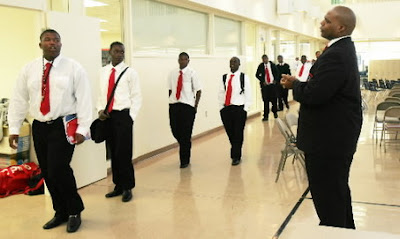
It is the well-worn path of imperial cultures. Force those not born "like" the elite to first convert, and then run in a futile attempt to "catch up."

Mr. President, is that what you would want for your daughters?

Acting as an equal human is intolerable in empires - watch from about 4:30 in

The KIPP "SLANT" idea, shown below being introduced by a smug rich guy I cannot identify, is reductionist education which assumes that children of color are incapable of the kind of rich learning available to their wealthy, white counterparts.

White guy spreading his culture to the great "unwashed" oops "challenging"

But let us notice, white kids don't learn that way... whether very young...

Montessori

or older... 

  St. Ann's Puppet Parade 2009
- Watch more Videos at Vodpod.
St. Ann's in Brooklyn Heights

or older...

Wingra School in Madison, WI

or older...

Scarsdale (NY) High School

President Obama, I believe that every child in this nation deserves the kind of creative, exciting, and culturally open education your children are getting at Sidwell Friends. And I believe that forcing a traditional concept of attention on children in order to make them "white enough" to be unthreatening second-class citizens is wrong on every level.

Let me quote this from the Middle School at Sidwell: "We seek academically talented students of diverse cultural, racial, religious and economic backgrounds. We offer these students a rich and rigorous interdisciplinary curriculum designed to stimulate creative inquiry, intellectual achievement and independent thinking in a world increasingly without borders.  We encourage these students to test themselves in athletic competition and to give expression to their artistic abilities.  We draw strength from silence—and from the power of individual and collective reflection."

Now let us see how much less KIPP kids get: "KIPP Academy Lynn Charter School will create an environment where the students of Lynn will develop the academic skills, intellectual habits and character traits necessary to maximize their potential in high school, college and the world beyond." "Academic Skills - Calculate accurately - Read fluently - Write effectively - Comprehend fundamental knowledge." "KIPP Academy Lynn will relentlessly focus on high student performance on standardized tests and other objective measures."

What research is it, Mr. President, that Secretary Duncan cites to indicate that the students of KIPP Academy Lynn Charter School deserve so much less - of life, of creativity, of respect, of freedom, than your daughter's classmates at Sidwell?

No Mr. President, KIPP Academies are not innovation. They are the oldest colonialist form of oppression in the school manual. They are institutions of the elite's cultural power, and their purpose is to protect the elites by ensuring that underclass children will never catch up.

But, if you really want to prove me wrong, send your daughters to a KIPP Academy. Your i3 grants mean there should be one coming to the White House neighbourhood soon.

- Ira Socol

06 August 2010

Barack Obama's Belief in the Least

On National Public Radio's Talk of the Nation on Thursday the topic was "How have discussions about race changed?"and Leonard Pitts, Pulitzer Prize winning columnist for the Miami Herald, said this:
"I actually want to go back to something that Mr. Gergen said because I think he touched on something very important. He was talking about the fact that so many people take it for granted that African-American and Latino kids are ineducable, and that this feeling persists, even in the light of empirical proof that this is wrong. I think when he says that, what he does is he hits on sort of a very fundamental truth about why we still have trouble with race in this country. We tend to make our decisions and tend to base our perceptions on caricature, which is impervious to fact.

"I've been writing in my column recently, about the drug war and about the fact that the overwhelming majority of drug users and drug dealers in this country, statistically, are white. And it is so difficult to get that past peoples filters, because in our minds and the popular imagination the, quote, unquote, drug user and drug dealer are some black kids on a corner in Baltimore.

"That's not the common - or the most common picture. But we have these caricatures, these, sort of, narratives in our head that we are absolutely stuck on and invested in. And we got to get beyond those before were going to make any kind of progress."
"so many people take it for granted that African-American and Latino kids are ineducable, and that this feeling persists, even in the light of empirical proof that this is wrong"

I listened to this the day after the Obama Administration announced its Educational Innovation ("I3") grants, and after I spent the day working - albeit remotely - with the principals of the Albemarle County Public Schools on expanding access to learning.

The winners of the "innovation" grant program: Teach for America - which provides untrained teachers for America's most vulnerable minority students while pumping up the resumes of rich kids; KIPP Schools - today's recreation of the US "Indian School" program for the "retraining" of minority children; and Success for All - a scripted reading program devoted to teaching reading as a skill, not a life function;  all have a few things in common, from campaign contributions to rich folks behind them, but especially, that they are all emblematic of the Obama Administration's belief "that African-American and Latino kids are ineducable." 

If Obama thought differently he would not be pouring education funds into reductionist programs that no middle class or wealthy parent would accept for their child. If Obama thought differently he would be pouring funding into what we were doing in Virginia yesterday - dreaming about how to give all of our kids all that they need.

We can't, of course, be surprised. After the British election American friends were stunned that Liberal Democrat leader Nick Clegg would make a deal with the Conservatives, who after all, differed from the Lib Dems on every policy position. I had to point out that "class trumps all," and that Clegg and David Cameron went to the same schools, grew up in the same social class. There's nothing in Clegg's life experience or education to connect him to any other social class than that which he shares with the Tories.

Similarly, as Susan Ohanian notes while quoting Frank Rich of The New York Times:
"Obama suffers from a cultural class myopia. He's a patsy for "glittering institutions that signified great achievement for a certain class of ambitious Americans." In his books, he downplayed the more elite parts of his own resume—the prep school Punahou in Hawaii, Columbia, and Harvard—but he is nonetheless a true believer in "the idea that top-drawer professionals had gone through a fair sorting process" as he had. And so, Alter writes, he "surrounded himself with the best credentialed, most brilliant policy mandarins he could find, even if almost none of them knew anything about what it was like to work in small business, manufacturing, real estate, or other parts of the real economy." Especially education." [italics are from Ohanian]
I listened to candidate Barack Obama speak in "The Circle" of Michigan State University's old campus in September 2008 and he told the students there that he had been "lucky" as they had been. "Lucky" to have this opportunity to attend a great institution of learning. And I loved that. Those of us who have had the chance are lucky. We are not "better," for the most part, we've had better chances.

But deep down Obama doesn't know that. He still sees himself working incredibly hard for his chances - which, yes, is true if you compare his life story to his presidential predecessor's - but he forgets that when he was woken up very early to do schoolwork with his mother, he was being tutored by one of the most brilliant and highly educated women in America. That he was surrounded by educated family. That he was off to an elite prep school when the bell rang. Even that he was living in a place where his mixed race status was much less an impediment to success than it might have been in many other places in 1970s America.

He only remembers his own effort. And that is all he sees when he "listens" about education. He assumes that the Ivy League (or Johns Hopkins) elites have "risen to the top" because they are the "best" - when, in fact, they are often simply the "luckiest."

The inevitable - essentially unavoidable - philosophical flip side of this is that non-Ivy Leaguers, non-elites, are less intelligent, that, in America's mythic Horatio Alger belief system - if you are poor it is because you are lazy and less worthy.

So, in Obama's world, those "African-American and Latino kids are ineducable." Thus they won't get fully trained teachers. They won't get the arts and music and creativity that Michelle Rhee thinks they don't deserve. They won't get tech-supported access to literature or reading for fun or reading for the information they're interested in. They'll get the scripted drill and kill teaching methods the United States has always used for kids society has determined have no chance to move ahead. They'll get the abusive colonialism of white role models and training in how to be white - which, I'm sorry President Obama, is NOT the only way.

In Virginia yesterday we were trying something different. In a diverse - racially and economically - school district we were hunting for the best ways to give it "all" to every kid. To find ways to let "everyone into the club." We were working on how to increase the training and skills of an already highly-trained teaching staff. We were looking for ways to add flexibility and student-centered learning to all phases of education. And everyone in the room was committed, equally, to every student. Of course this district's innovation grant applications were not funded.

Listen: I campaigned for Barack Obama. I voted, with delight, for Barack Obama. I appreciate what he's done for America in many ways. And Barack Obama has me in a bind. Can I really vote the other way in America when the only other choice is a political party so right-wing extreme it would be banned in most other "NATO" nations?

But Barack Obama is hurting America's most vulnerable school children because, in his heart, he does not see them as his equal, he does not believe in their potential. And that is a terrible, terrible thing.
Way back in 1969 there was a series of television ads: "In the "Give a Damn" campaign for the New York Urban Coalition, a black narrator suggests to white viewers: "Send your kid to a ghetto for the summer. Want to see the pool? C'mon. The kids clog up the sewer with garbage, open a hydrant . . . You don't want your kids to play here this summer? Then don't expect ours to."
Well, 41 summers later, Barack Obama, if you wouldn't send your children to a KIPP Academy. If you wouldn't accept an untrained teacher for your daughters. If you wouldn't want your kids - if faced with a learning problem - to be read a script which disregards their needs. Then don't send our kids to these schools either.

All of our children, even if they are poor, are black, are latino, are "disabled," even if they have "disinterested" or incompetent parents, deserve our very best. So please, let's stop "racing" - and let's stop dividing - and let's start creating opportunity.

- Ira Socol
if you agree - send this to The White House and send it to all of your local/state Democratic candidates.

06 December 2008

Who's Behind the Curtain?

I ended up in two big educational debates this past week. One was about "clickers" - those "Classroom Response Systems" that are increasingly infiltrating our classrooms. The other, about Washington, D.C. Schools' Chancellor Michelle Rhee and "the reform agenda for schools" coming from America's financial elites.

In these debates I was abrupt, and cruel (sorry, David Brooks, I know you are only doing your job keeping Wall Street Republicans reading The New York Times, I shouldn't have gotten personal - and a very big apology to Roger Cohen, another NYT columnist, who I blamed in bizarre mix up), and perhaps, in a few moments, coherent and convincing. I read wonderful stuff from passionate people too.

But stepping back, I want to bring both these debates together, because, in the end, they are both about power, about who gets to control education in the United States (and thus who the "winners" in education will be), about who is pulling those levers from behind the curtain.

Michelle Rhee is riding the broomstick, but it is a different Wizard of Oz image I'm interested in...

We have two tidal events occurring here, but these are not natural tides, they are invented ones. And when people seek to create tides, I think we should always ask why.

So, in a higher educational establishment which, for example, has refused to even load their computers with free universal design software technologies, much less invest in those systems which might transform education for a vast array of students now failed by the system, we see broad adoption and massive spending on "clickers."

And, in a climate of broad K-12 system failure, with hundreds of fascinating alternative success examples from around the world, the US media establishment (Disney, Time-Warner, GE, Viacom, NYT Company) has declared one "leader" - a leader with no measurable accomplishments and a confrontational style which seems to drive almost everyone away - as education's messiah.


hero worship

But let's start with the "clickers." Michael Bugeja, a friend and technology in education sparring partner (and the Director of the Greenlee School of Journalism at Iowa State University) wrote a piece this past week in the Chronicle of Higher Education - a paid publication I rarely read and a paid website I rarely visit. His commentary, Classroom Clickers and the Cost of Technology, tracked the adoption pattern of these one-way communication systems on university campuses.

"Marketers seem to know our business better than we know theirs. That was apparent a few years ago, when publishers introduced infrared clickers bundled with specific textbooks or series of textbooks. In a class of 400 students, each of whom would spend $40 for a clicker, many institutions paid for the purchase and/or installation of receivers, in effect helping to sell the company's products. Companies suggested clickers for multiple-choice questions based on a book's content, an easy adaptation from previous instruction booklets with answer keys — not exactly innovative, but cost-effective, making books appear interactive overnight."

Bugeja - who I often debate regarding technology adoption in the classroom - but whom I deeply respect on the subject, even when we disagree - is concerned with the cost/benefit calculations behind the "clicker decision" as well as the key question of who is pulling the strings.

I have been "clear" about my position on clickers - calling them "Instant Anachronisms" and "Coercive Technology." Even when I see some possible benefit - bad lectures may be marginally better with clickers than without - I regard this technology as "insufficiently transformational" - that is, not worth the costs in a nation where students already can not afford higher education.

But the key issue here is "why"? Who has pushed this technology, and to what end. I joined in a fascinating debate on this at the blog of Derek Bruff, a math professor and director of the Center for Teaching at Vanderbilt University, and major "clicker advocate). If you follow that debate, you'll see where it leads. Why is Turning Technologies selling clicker receivers cheaply? Is it because it hopes to tie Vanderbilt's faculty to the textbooks of its partners? Those partners? Thomson Learning, Glencoe McGraw-Hill, Dell Computers, Steljes Group. Oh. The primary distributors of the $150 textbook are "giving away" (sort of) systems which will seemingly guarantee the continued sale of $150 textbooks.

Those marketing Universal Design Technologies - Freedom Scientific, Text-Help, Kurzweil, etc, can't afford to "persuade" universities this way, but Thomson Learning (or is it Cengage now?) sure can. And thus we find "clickers" everywhere, and struggle to discover transformational technologies on our campuses.

Dr. Bugeja would want me to suggest that we always follow these trails. And when I sat in a meeting with Google's Jeff Keltner regarding Google Apps for Education this semester, I heard all the questions. Why would Google give away a campus email and collaboration system (stripped of the advertising which is Google's only real revenue stream) for free? What's the catch? Keltner (as Google execs tend to be) was blunt. People who use their tools tend to use their search engine and, quote, "we're pretty good at monetizing that." And, "we see students as future leaders, if they become comfortable with our tools now, they'll tend to use them later in their lives."

Yes this is insidious seduction, it sure is, but let's consider this cost/benefit balance. What does your university (or school) spend on email? If that email system was free, could you not raise tuition? Could you hire more faculty? Could you put WYNN on more campus computers? But here's the thing, Google will seduce, but they won't bribe. They won't hand a toy to a faculty member at a conference which transforms that prof into "a techie" in the eyes of his or her peers. They won't give out free books either. So their "leverage" in campus decision making is limited. As we may deduce from observing the number of campuses spending their own and student dollars on "clickers" vs. the number cutting costs by adopting Google Apps for Education.

The Universal Design Tech companies? Without the profits from 700% textbook markups, or the alternative revenue stream of Google, they struggle to bribe or seduce. Even when their products are free, they remain of little interest to universities - despite, well, what's the cost/benefit relationship there?

Which brings us back to Michelle Rhee. Who's marketing her, and why?

Rhee is part of a broad push by America's true "old guard" to ensure that education doesn't really change. The same folks at Harvard and Penn who offer our minorities the lowest educational expectations possible through Teach for America and KIPP Academies, are selling you Rhee, and lowered expectations for all schools - except of course, for the schools attended by the children of those elites.

There is a reason the television networks and New York Times and Time-Warner love TFA and Rhee. These organizations are run by people with power, and by people who would rather not share power.

So they have adopted the ultimate in reductionist standards. "If we had even decent education - or even enough teachers of any kind - in most of the places it places its students, then [TFA] would be a step down," a commenter on this blog said yesterday. Right, so here's the standard: Teach for America, or Michelle Rhee's DC school system, is better than not having schools at all.

Rhee's own words: '"People say, 'Well, you know, test scores don't take into account creativity and the love of learning,'" she says with a drippy, grating voice, lowering her eyelids halfway. Then she snaps back to herself. "I'm like, 'You know what? I don't give a crap.' Don't get me wrong. Creativity is good and whatever. But if the children don't know how to read, I don't care how creative you are. You're not doing your job."'

No, she doesn't give a crap. She wants her African-American students prepared for the lowest possible jobs on the economic ladder. That way (perhaps, in her unconscious thinking) they will not threaten the success of her small minority group - a group which has found itself accepted by the powers-that-be because it isn't big enough to be threatening.

Of course I have a different view of reading than Rhee, and of language itself. First, I know that there are lots of ways "to read," and second, I know that when children are inspired to learn about things, they tend to want to learn to read (in one form or another). As opposed to the Joel Klein-Michelle Rhee-KIPP Academy-George W. Bush notion that reading is a skill which should be learned outside of the context of interest-based education.

But then, my goal is opportunity, and my belief system - not being market-capitalist in nature - doesn't think an underclass is a good idea (to hold down upward pressure on wages).

Rhee is not important, of course. She's racist in her expectations and racist in her strategies, she's not an educator at all in the real meaning of that term, she talks a great deal but has little actual impact in her job. But Rhee being hailed as the educational messiah is important.

Like those who favor TFA solutions - the Rhee idea is to NOT change US society. Yes, we'll make impoverished minority groups marginally more competent - thus improving profits at the top and reducing the cost of the dole. But no, we will not empower those groups by empowering their children. Teaching them to be creative 'will have to wait' (forever). Teaching them to find their own learning styles - thus accepting cultural change instead of social reproduction - is dangerous (as it always is for those at the top).

We lower expectations. We test meaningless things (Time: "The ability to improve test scores is clearly not the only sign of a good teacher. But it is a relatively objective measure in an industry with precious few. And in schools where kids are struggling to read and subtract, it is a prerequisite for getting anything else done." Really? Anything? You can't teach the physics of a bouncing ball to a non-reader, or the love of literature?). We strip time away from what is precious to children and force them into chanting. We enforce white majority cultural norms and deny identity. We argue that teachers should be paid according to the "short term gain" rules that worked so well for traders at Citigroup and AIG.

And this is all brought to you by the wealthiest people, and the largest old-line corporations in the country. Because, I'll say it again, they have no incentive to allow those below them to succeed.

Follow the money my friends. When information flows freely to as many people as possible, Google makes money. When information is expensive, those who sponsor "clickers" make money. When the kids in Washington, D.C. schools fail, there are fewer challenges to the children of New York Times and Time editors for slots in Ivy League schools. When Washington, D.C. schools focus on "the basics" students from there will not beat out the son of a GE exec for a spot at Carnegie-Mellon.

When you see invented trends, pull back the curtain, see who's pulling the levers. It is important.

- Ira Socol