If you want to design your school... from scratch or in reshaping... you need to begin with two questions...
First: What is the point of your school, in blunt terms, or, in more "professional" words, What is your school's ethos? Why should a child come to your school? What will your students have at the end of their time in your school which will move them toward being happy, competent, capable, passionate adults who will have real choices in their lives in the Mid-21st Century.
And Second: What is the "User Experience" of your students, and what should that User Experience be to best move all students who come through your doors to get to their goals?
Only if you answer these questions can you begin to imagine/design/create the "User Interface" - which in schools is our building, our grounds, our schedules, our curriculum, our pedagogy, and all of our rules - so that all that our "process" is contributes to our goals.
A few days ago I asked a group of elementary (primary) teachers who were wondering about their cafeteria, "begin with, what are you trying to help students learn while they are eating together in your school?"
In the user experience of "school" our users, our kids, see and respond to absolutely everything. Yes, adults do that as well, but adults, in that "the more you know the less you see" filtering, actually see/hear/feel/smell/taste far fewer environmental clues than do kids. So, when a group of American teachers told me, after I had told a story from an Irish Primary School, that "those teachers are teaching life philosophy and not just content," I responded, "I think we are teaching philosophy every minute, it just might be life philosophies we don't much like."
Kids respond to everything...
Henry Barnard, the "evildoer" who designed the American multi-classroom school as we know it, wrote that everything which students saw and did from when they first saw the school in the forming was important - that every entrance, corridor, even where a child hung up their coat was part of the educational process. And he was, in this, absolutely right. It explains why school architecture from 1850 to 1950 often mimicked the authority structures of their age, from churches to courthouses, and it explains why students were pushed to line up - to form queues - entering the school, as compliance, order, and hierarchy were being enforced long before a kid ever got to his or her seat. And why schools after World War II looked like the factories and military facilities of that age.
An hour before school - high school library, Charlottesville, Virginia
website where I found this 1960s school image sees nothing in doors to the outside but, "poor security"
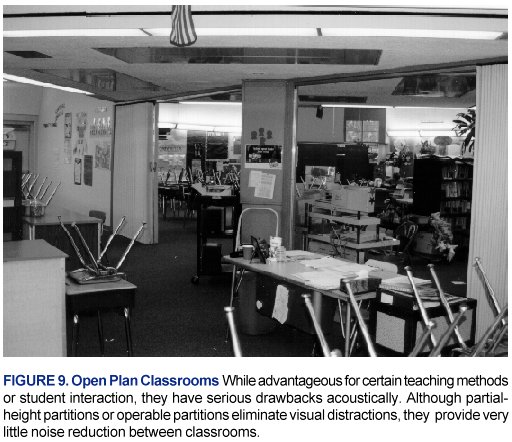
But school design and user experience have hardly ever been joined. Even the John Dewey influenced schools with all the doors to the outside of the 1950s and 1960s (really just a recall of William Alcott's ideas of the 1830s-1840s) were taken from the architects by school administrators who never asked the kids how these spaces could be used. And the "failure" of the 1970s open classroom school buildings was never a failure of architecture, but a failure of almost every adult who worked in those buildings to comprehend the idea of "user experience" - they tried to run Henry Ford's 1913 assembly line in a renaissance studio.
Simply put, the reason we find ourselves stuck in Industrial Revolution Era schools, the reason school success in the United States has only crawled from the 1850s adult design of succeeding with 20% of students to our present succeeding with 33%-40% of our students, lies in our inability to begin to match the User Experience of education to what we really want education to accomplish.
Third graders create their computer lab
So, what do we want for our children? If we want them - all of them - to grow up to be critical thinking global communicators who can investigate and succeed with the widest range of choices possible... effective citizens of democracies able to collaborate with each other and make a better world... voracious creators who absorb stories and information and use all that to dig out the problems which bedevil us and build solutions to those problems... empathetic, healthy members of a planet, a society, a tribe, and a family... well... what is the design of our schools - again, spaces, schedule, pedagogy, curriculum - contributing to those goals? and what is doing the opposite?
Working voluntarily and comfortably, in many ways
Last week we turned to our users to try to understand. We asked 500+ "elementary" school (primary, grades K-5) students - all the students of one school - to participate in a charrette to help begin to design the future of their school. We did show them a few images to begin to free them from "the understood," but we worked really hard to limit any adult influence on this work. We adults have seen so many schools, and we "know" way too much - especially about what we think is impossible - and we needed kids to show us the vision they would build with their unblinkered eyes.
We got many, many ideas - from Kindergärtners wanting cow tables and a castle with a dragon (what good is a castle without a dragon anyway?), to multiple requests for rooftop reading decks and reading treehouses, a cafeteria softserve machine, a soft student lounge, rolling science labs, movable cubes to read/work in, carpets, bean bag chairs, more outside doors, a big slide to get between the upper and lower playgrounds (ending in a trampoline or not), more art, gym every day (they currently have it four times a week), a zip line to get from one end of the school to the other, far more color - and kid-relevant color - in the school, a "giant robot bluebird which would walk the hallways saying hi to students," and choice - choice - choice...
Third and Fifth graders at work in Charrette, we had paper, and we had video cameras they could explain ideas to...
Choice in classroom seating (or choosing not to sit), choice in tables/worksurfaces, choices in how to read books, choices in when to do what, choices in working inside or out, choices of where to play, and the choice to do work in school - with their peers - not at home with their parents.
The ideas spilled out in all directions...
None of this is absurd. None of it. Why can't kids get softserve frozen yogurt after lunch? Why can't the school build a castle and a dragon with the 5-year-olds? Maybe a zip line could cross the playground? You'd have to be a pretty weak teacher not to be able to use that in teaching many parts of the curriculum. When I mentioned the robot bluebird to Melissa Techman, one of my favorite school librarians, her immediate response was, "that's why I need those big cabinets I want so I would have all the stuff to build that kind of thing all ready."
And why can't school teach constant, continuous, internal feedback informed choice? How else can we help kids grow up into citizens of a true democracy, and able to make choices which work for them as adults?
Fifth graders eat lunch and debrief the ideas - "what will grownups say no to, and how do we argue with them?"
Essentially, if I took in the vast amount of ideas and grouped them quickly - they wanted choices, comfort, warmth (many requests for wood floors), the ability to be outside, better lighting (dimmer switches, lamps), and places to both work together and to get away to quiet. They wanted to explore the world not just read or hear about it. Plus they wanted a school that was fun and that they looked forward to entering every day.
Anything radical there? Anything which really isn't part of our kids learning how to be the mid-21st century citizens and humans we want them to be?
Our next steps seem like a curriculum built in a great dream - some kids will inventory the school and grounds - what do we have now? how do we use it or not? Others might label the trees and plants around the school. Some might consider how a swing becomes a place to teach physics and math and perhaps poetry and decide how that might work. Still others might work over the idea of what might be quick, and what takes big resources and thus more time, along with what might be easy - and what might be very hard.
And we think the end result will be a better school, better learning, and kids with more skills and more capabilities. Which is what we want our user interface to help create, right?
Language limits us. Surely, written and spoken language limits us, written, perhaps, most of all.
That isn't a knock on language, an incredible tool - technology if you will, which has enriched the lives of humans in remarkable ways. But every tool has its limits, has things it cannot do. Even my "Sawzall" really isn't even that, and its a crappy hammer by any measure.
So, at times, we must reach beyond language, with ourselves, surely with our students, and see if we might liberate our brains.
2001 A Space Odyssey - Arthur C. Clarke and Stanley Kubrick don't use "language" to describe their tablet computer device, well, not word-based language
Next week we're going to attempt a charrette on the future idea of school with an elementary school in Virginia. A charrette including all students from age 5 to age 11, with a mission to imagine far beyond the concepts of "school" we all know.
our imagination can look a lot like the past, a 1958 TV version of 2050
But how do we free these kids from what they know? That's not an easy thing. In all the science fiction I have seen from before 1980 only two authors, Arthur C. Clarke and Douglas Adams imagined anything like the computers which have come to be. Everywhere else we see analog dials, old radio-style tuners, and 1950s shaped TV screens. Yes, Star Trek had slide controls, an idea which came from theatre lighting controls, but its pretty much like today in education, where people speak of "the iPad (2010) as the future," because they have no words for what is coming next.
So, if we say, "a place for education ten years from now," how do we avoid the deeply constructed definitions we now have about "school," the "school day," the "classroom," and everything else?
We all know what a trap these definitions are. Lots of supposedly intelligent adults moan and groan in whatever forum will give them space about "kids today not reading" because they cannot comprehend "reading" as anything not associated with the Gutenberg-Era definition of a book. Many school librarians still think that if "it" is not traditionally edited - if it might contain contributions from the 'academically unwashed' - "it" is not valid. Many teachers - most state legislatures - the US Department of Education - believe that a report must be "written" to have real value, and that "knowledge" is not "knowledge" unless it can be expressed via a multiple-choice exam. Plenty still believe that I cannot read because I listen to books.
The library at the College of William and Mary is still fighting Wikipedia, which, is not a "book."
And let's face it, if you really can't understand crowdsourcing (the present), how are you going to imagine the next thing? If you can't imagine the classroom without student (or teacher) desks, how do you imagine - or even understand a description of - what the students of 2020 will need? If you still think "tardiness" or "late assignments" are a problem, how can you comprehend the evolution of continuous learning?
Always a problem: In 1900 the French imagined some radical changes, but the classroom looks suspiciously similar (now and then).
Thus, I hope we can get these kids up and moving, talking, writing, drawing, moving blocks, moving furniture, making, playing, drawing in the dirt - a sandbox? really... - singing, dancing, doing whatever they can to give understanding to their imaginations, so we will not be limited to the ideas we already have words for. For if we already have the words, the ideas are not really new, right?
This is our challenge. Imagination without the limitations of our experience might be the single most difficult thing a human can do. But if we can help our kids do it, their school experience will be worth the time they've invested in it.
"Ethos
is a Greek word meaning "character" that is used to describe the
guiding beliefs or ideals that characterize a community, nation, or
ideology."
A Twitter conversation led me to this place. What does a place of learning need to welcome all, to offer all the kinds of paths to the future which our children need?
I settled on a set of four thoughts: One Ethos, Open Culture, Many Paths, Many Tools.
If that is the belief system, I think that the rest - the pedagogies, the spaces, the schedules, the ways we treat each other, and the kind of deep, inspired learning humans deserve - will follow.
One Ethos
High School Math Teacher (1996): "That damn kid, he's rather go to Saturday School than come to my class." High School Librarian (replying): "Well, you'll have to think about that!"
Why would a student come to your school, if she/he were not forced to? This is a question you must ask every day, as every teacher ought to ask, Why would a student come to my class...?
What does your school, as a whole and in every space inside, offer children? Safety from unsafe families or communities? Food which otherwise be in short supply? A chance to hang out with their friends? Do they come for just one teacher, or only because of music or sport? Is that good enough for you?
These kids of questions are rarely asked in American education, though we fill millions of square feet of wall space with "mission statements" and "learning goals." We just don't ask, "What is this school for?" In fact, we avoid that question so deeply that last January the US President got up in front of the nation and actually suggested that the solution to high school dropouts was to make dropping out illegal. Talk about giving up...
So why? What do you - as an entire school - offer every student that would make them come if compulsory attendance laws and the parental need for babysitting disappeared? Would they come because they understand that your school is a safe and happy place in which they are offered a world to learn in a somewhat less-risky-than-real-life situation? Would they come because they are excited about what they invest in when they walk through your doors? Would they come because they find the push to discovery, learning, and growth to be inspirational instead of coercive? Would they come because you offer a great collection of paths to an independent future? Would they come because you offer a laboratory for democracy and life - that you are - all together - creating a future better than the present?
I cannot tell you why... but you must find this answer, and that answer is the ethos your school must embrace - universally.
Open Culture
I'm not against the"Common Core" because I'm a crazed postmodernist. There are other things I'm against because of that. And I'm not against the "Common Core" because I doubt the need for us to share some commonalities of knowledge.
I'm against the "Common Core" because it is neither "common" in my experience nor is it generally at the "core" of what people need. Instead it is part of a long history of education as Pygmalion - to use George Bernard Shaw's lovely mythological metaphor.
"None of this is new. "Established in 1914, the Ford English School
taught the company’s immigrant workers more than just how to speak
English. It taught them about American culture and history and
instilled the importance of such virtues as thriftiness, cleanliness,
good manners, and timeliness." There has always been a tension in the
United States between the expressed ideal of a multi-ethnic,
multi-cultural society - you know, that brilliant combination of
ethnicities in any World War II film - and the reality on the political
ground, which is that "our leadership" would find things "much easier"
if we were all "white, protestant, straight, northern Europeans,"' I wrote more than a year ago, while pointing out that even that belief is a lie, a cover for something else, that is, if school is about being a "white, protestant, straight, northern European," it guarantees that those now in power will watch their children begin school with an insurmountable lead on everyone else, thus assuring social reproduction.
People think the "Common Core" is inclusive because teachers can choose books, but in this, they miss the point. The "Common Core" is "white protestantism" because of the values it suggests while pushing all children to meet Middle Class Age "Appropriate" Learning Targets - or in their carefully crafted words - "provide teachers and parents with a common understanding of what
students are expected to learn. Consistent standards will provide appropriate benchmarks for all students, regardless of where they live."
What if it doesn't really make a f---ing bit of difference to my kid's, or my community's, life, if my 7-year-old doesn't... "by the end of year, read and comprehend informational texts, including
history/social studies, science, and technical texts, in the grades 2–3
text complexity band proficiently, with scaffolding as needed at the
high end of the range"?
Pygmalion, why are you superior?
Could my 7-year-old spend that year investigating physics with balls and paper airplanes and by building bridges instead? Or learn to speak the languages which might surround her in our community? Or learn measurement concepts by learning to cook? Or might he just want to listen to, and tell, stories? Or, as was the case of my kid at that age, was he far more interested in adult reading and music than in the "grades 2-3 text complexity band"?
In Finland, much of Scandinavia, kids don't even begin school until they're 7-years-old, and since the "Common Core" claims to be built on "best practices," and Finland tops those international comparisons, maybe the alphabet is the best cultural target. In Ireland I watched 7-years-olds from all over participating in classrooms with kids up to age 12, with all that subject matter, but mostly... participating by listening and talking.
A culturally diverse school is not about flags in the hallway or "welcome" written in a bunch of languages, its about being a learning space where kids get to negotiate how their culture meets the others around them. Where, say to begin, holidays are shared on equal terms, without pressure to either "opt in" or "opt out." Where time is respectful of cultural differences, whether it is Ramadan and Yom Kippur or "on-timeness" or "appropriate speed." Where communication is accepted and developed because it is authentic, not because it meets E.D. Hirsch's cultural expectations, and as it is developed, we all learn to communicate more widely, and we learn far more about communication choices.
A culturally diverse - a culturally "open" - school also refuses to grade by compliance to Anglo norms. It is not a question of why read For Whom the Bell Tollsinstead of The English Patient, but rather, the violence you will do to The English Patientif you try to analyze it and write essays about it "the common core way"?
Many Paths
Where is the student now? Where does the student want and need to go? What are the possible ways to get from point A to the much more nebulous point B?
There is really never one way to learn anything, to read anything, to write anything, to calculate anything. There are always choices, and there must be choices - unless we plan to never improve as a species. "Why is fastest better?" I once heard James Gee ask. "Why is the shorter proof better in Geometry? Why is it better to finish an assignment faster?"
Or why is a five paragraph essay better than a one paragraph argument? Or a ten page rant? If this were true Tom Clancy would be a better writer than James Joyce or Virginia Woolf or Colm Toibin, and (let me just assert this truth), he is not.
If all the rules were true, this wouldn't be great literature
Or, why should addition come before calculus? Or biology before physics? Or why is music composition less important than reading about Abraham Lincoln? Or why can't soccer practice count as math class? Is it about "rules," or is it because educators are not imaginative enough to help students pursue the world their own way?
It is way past time to stop imposing single solutions on our learners, Neil Postman and Charley Weingartnerrecognized the choices created by (then) new media in 1968 required teaching practice to radically change. You are now over 40 years late.
And that lateness has been horribly destructive. I am sorry to have to tell you this, but the majority of students leaving American schools at the end of 12th Grade (or before), will describe most of their education to that point as an irrelevant waste of time. That's because it is not "their education" at all, but something imposed on them by people who appear to have nothing in common with them.
Many Tools
"Most of us lack all kinds of powers. I can't lift my car by the
bumper in order to change a tire. That's what jacks are for. I can't add
long columns of figures in my head. That's what calculators are for.
Tools give us the ability to make up for what we lack in native powers." John Perry in the Wall Street Journal.
I believe in Toolbelt Theory, which begins with the concept that we humans are, perhaps above all, toolmakers and tool users, and that thus, in the education of our children, the most important thing we can help them learn is how to be very good at both. "After all," I tell people, "without tools humans are a very long way from the top of the food chain."
It is human to make, choose, use tools
Schools need to stop limiting tool use and equating tool use with "cheating."The tools of today are incredibly powerful, incredibly diverse, and create never-before-seen opportunities for so many students failed, consistently, by our one-size-fits-all education system, that we must embrace these tools, and help students learn to get the most out of the technologies which sit - or will sit - in their pockets. We can't do that by limiting, filtering, and blocking.
Right now, right from the first day of school, every student can read from paper, from a computer screen, from a tablet screen, from a mobile phone screen, or listen to their computer, tablet, or phone read to them, or some combination of those things. Right now, right from the first day of school, every student can write with a pen, a pencil, a stylus, their finger, a big keyboard, a little keyboard, a touch screen, or just by speaking. Right now, right from the first day of school, every student can communicate through text or speech, audio or video, music or art, with much of the world. Right now, right from the first day of school, every student can pull in information from anywhere on the globe, at any time - and truly - that is a skill you must help them learn to do well. And we can't do that unless the tools are present every day, all the time, so that we can all learn what works for each of us.
One Ethos, Open Culture, Many Paths, Many Tools. Because if education matters, it matters enough to do the right things for our kids.
If we must have grades - and I would argue that grades, letters or numbers suggesting some percentage of accomplishment, range in actual value to the student from meaningless to worthless - then, at least we ought to have fair grades.
So here's a school year start plan for administrators. Let's have zero tolerance for any teacher ever giving any student a "zero" on a "one hundred point scale." In fact, if you use digital gradebooks, and in the US and Canada you probably do, go in right now and change the parameters to make this impossible.
The reason we cannot tolerate zeros? It is completely absurd to give any student a grade below zero on any assignment, test, or task just so the teacher can f--- up the student's semester and year. And zero is always far below "zero."
In traditional grading there is a 36 point scale, with "64" equalling "failed to meet a minimum" and "100" equalling "did I everything I told you to do." This equates to the classic US university "Four Point Scale" in which 0.0 is "failed" and 4.0 is "totally compliant." And no one at a university ever gets a grade of -6.4, because, well, that's ridiculous, as is any teacher giving any student a -64%.
A scale is a scale, and failure is failure, if you believe in quantifying failure rather than teaching with it. There is nothing - in any rational grading system - below failure.
Zeros are one of those brutal coercion tools some teachers use, and brutality has no place in our schools.
"The STOPPED
program -- Sheriffs Telling Our Parents and Promoting Educated Drivers
-- provides signed-up families with a stop sign sticker with a unique ID
number. That sticker is placed on the windshield in the upper corner of
the passenger's side.
"When a vehicle with a STOPPED sticker is
pulled over, deputies report the reason for the stop to the Michigan
Sheriffs' Association using the ID number, which then sends an email to
parents regardless of whether or not the teen is ticketed."
Whenever I see schools leaping onto the massive hypocrisy bandwagon, the "let's distrust all students" bandwagon, and even the, "let's usurp parental rights" bandwagon, I know the moral compass is way off.
For schools with no alternative parking options (which includes some of these), the right to, say, work after school is no dependent on a student giving away constitutional rights - that presumption of innocence. It is also dependent on giving away any right to privacy. If I attended one of these high schools, this rule would push me right out the door, permanently - and honestly, I think I'm a pretty damned good driver.
Why not just implant a GPS device under the kids' skin? Well, they'd probably like to do that. Most of these communities are incredibly unsure of their abilities as parents - so unsure of themselves and their morality that they automatically assume any child out of their sight will be doing "the wrong thing," so, again, no surprise, but...
I have another idea. I think that any adult involved in the school system - faculty, administration, staff, school board, should be subject to the same rule, except, in this case, every police stop will be reported to the students in their schools and to the newspapers and television stations. After all, mistrust is a two-way street.
Team Handball, basketball without the height issues, equipment cost? near zero
Like many in the world, I've been watching lots of sport(s) this month. And as I do most Olympic years, I wonder why American schools spend so much money on so few sports for so few students.
Archery... why not? It might allow boys and girls to compete together, it would surely allow kids who might use wheelchairs to play team sports with other kids.
This isn't an issue for schools elsewhere in the world who can rely on intact communities to support youth (and adult) sport(s), but in the United States it is a huge issue. In most communities I visit certain sport-activities receive massive funding from the schools, while most students miss out entirely on the benefits of this kind of physical activity joined to social learning.
As I used to say, often, when I was fighting for soccer programs for boys and girls at North Muskegon High School in Michigan - if varsity athletics have educational value they need to be available to every student who wishes to participate, if varsity athletics don't have that kind of educational value schools surely should stop including them in their programs and budgets.
Hurling, another relatively low-cost sport with high participation potential (much cheaper in equipment costs than lacrosse, and without the negative role modelling)
My thought has always been this... the purpose of varsity athletics is participation, pursuit of the personal best, and teamwork. It is not - it cannot be - about American public schools needing to entertain an overweight population snacking on hot dogs after tailgating. It infuriated me that when I suggested that Penn State play football without fans, many said this was "unfair to the players." As someone who played sports few, if any, watched, I wondered, how sick is our academic athletics environment if the only purpose is externally-provided gratification?
Croquet... why not?
With this in mind I am always on the lookout for athletic opportunities which could involve a bunch of kids, especially kids usually left out, while using shared - not new - facilities (even if that cuts down some practice time for some other sports, which is a side benefit for everyone). If you have a pool, do you offer boys and girls water polo? If you have a field do you offer boys and girls lacrosse, hurling, field hockey, rugby (you might do both Rugby Union and Rugby Sevens)? If you have a gym do you offer boys and girls team handball, and team volleyball? If you have some space outside do you offer boys and girls archery, and croquet?
Women's Rugby Sevens. The equipment will not break your budget.
None of this will cost much, beyond a certain diversion of resources (including assistant coaching positions from some sports being shifted to head coaching positions for these new activities), except for lacrosse (and perhaps archery), equipment is cheap, and lack of many opponents is not a problem - a multi-high school or middle school district or division could form its own league, or just a couple of nearby towns could do this together. Remember, the National Hockey League played for 25 years with just six teams. It is still remembered as the glory days.
And most importantly, opportunities to redefine the school culture and climate will be created. There will be less of the elitism which inevitably surrounds the few "important" activities.
So dive into the list of Olympic sports, past and present, and see what opportunities your school can add.
One of the statements which drives me insane is the teacher who tells me that they must, "set the strict rules from the first day, then they can ease off later." I always "suggest" that when they do that, they not only lose all the respect of their students, the literally create a room full of enemies, and if they try to "ease off" later it will go as well as... say the last days of the East German or Romanian Ceauşescu regimes.
"We cracked down, then we allowed a little more freedom"
the end of the Romanian dictatorship, 1989
If you want to begin the school year educationally, creating an ecosystem designed around student learning, you surely don't need to begin as a "tough guy," you instead have to throw out all of your "classroom management" strategies and probably almost everything else your school usually does the day kids come back from summer holidays...
Here are ten things to change at the start:
1. Do NOT welcome kids to a "new school" or a "new grade" - that's your vanity showing through, and it insists that children adapt their learning to you, instead of the educational ecosystem flexing to meet the child. Instead, welcome them to a "continuation of their learning" and of "their life." As I will say over and over here, school is about the children, it is not about the adults - it is about meeting students where they are, not creating hoops for trained monkeys to jump through.
"Step in, sit there" - Alcatraz, early 1960s
2. Do NOT assign seats, or even require sitting - imagine, you walk into a party and the first thing you hear is, "sit down over there and shut up." I, for one, am probably walking back out of the door and not coming back. If you start minute one of day one with an exercise in compliance, your school year is already "over" in many ways, and you've already lost half of your students in significant ways.
So say instead, "welcome, come on in, make yourself comfortable." If this space is to be your shared home for the next nine months, would you want to begin any other way?
3. Avoid the "ice breaker" events until you know your students well, and then they aren't needed. "Ice Breaker" games you have designed are - I'll assume unintentionally - designed to humiliate. Whatever they involve, writing, walking, running, reading, speaking may be incredibly difficult for some kids in the room, creating first day failure, first day humiliation, and, inevitably, justified anger.
Whatever age, whatever place, allow students to find their own places of comfort on day one, only then can you actually observe what the children in your room need.
4. Do NOT let your classroom be set up according to what you like - it is NOT your space, but "their's." I hear all the time from teachers, "I like this color," "I want my desk here," "I want to use this space this way," "I don't want kids writing on the floor, it's dirty," "I cannot handle too much noise," "If I don't have desks this way, I can't see." Lots and lots of "I" statements in a profession which is - quite definably - supposed to be about the children.
This moves from the (perhaps) minor, an odd love for motivational posters for example, to the ridiculous (and perhaps dangerous) - I recently saw an elementary classroom where the teacher had completely blocked the only classroom window with a "presidential-sized" desk of her own, and had filled the windowsill with her stuff so no child could possibly get to natural light. I often see middle school classrooms where teachers have covered every window, both to corridors and to the outside. I see school entryways painted in colors chosen because "the principal likes it."
It is NOT your space. It is the students' space and an essential part of education is learning to negotiate the development of shared space - especially in a society of one or two-child families, kids with their own rooms, and homes which separate instead of bringing families together.
"don't think, just repeat" Chaplin in Modern Times
5. Stop encouraging automaticity, cultivate mindfulness instead. It is time to embrace Ellen Langer and work to replace the "robot brain" so many schools encourage with the engaged mindfulness of students consciously making decisions. "Mindfulness, [Langer] tells the medical school audience, is the process of
actively noticing new things, relinquishing preconceived mindsets, and
then acting on the new observations."
Langer describes what is needed everywhere in education - “the psychology of possibility,” because, “...knowing what is and what can be are not the same things,” and for students, obviously, the "can be" is all important. If it wasn't, they'd be done.
So much that we do in schools to "create habits" works toward what Langer calls "mindlessness." If a child gets off the same bus each day, walks through the same school door, down the same corridor, to the same classroom, and takes the same seat, they have begun their school day by shutting their brain down. The same is true of everything from "homework every night," to memorizing facts - is our goal really the absence of thinking?
Automaticity - mindlessness - is an industrial efficiency concept. Don't think, just repeat. Does that belong in your school?
6. Hypocrisy doesn't work - it tells children that you are a liar and a tyrant. So many children go to schools where every adult eats and drinks while using their computers, but the kids are not allowed to do the same. Many teachers have beverages while kids must wait until "snack time." Many communities tolerate behaviors in adults - and in adult leaders - which would get kids suspended or worse.
This is especially true for the young adolescents who occupy American middle schools, kids who live in the most absurd world where the only sure way they can be treated as an adult is to murder someone, but they are constantly told to "behave like an adult." Either trust kids as the humans they are, or choose to treat them like animals - but understand - they will act as you expect them to act.
7. Do NOT overdecorate with stuff you've bought - let the kids make it their own. Don't fill your classroom with purchased stuff. A great way to begin the year is to make our children into "makers." Let them paint, draw, write, build, sculpt - their passions, their lives, their dreams - and decorate right from the start with what your kids have created.
Really? Really?!
8. Human dignity matters above all - do NOT take it away. A few things must be unacceptable across your school - no one should have the right to tell someone else when they can or cannot use the toilet, no one should have the right to tell someone else when they can or cannot move to make themselves more comfortable, no one should have the right to imprison anyone in a space without something like "cause."
Now, none of this suggests that we don't learn to negotiate all of this within our own community - "how do I get up and head toward the bathroom?" "how do I move from my chair to standing in the back without bothering people?" "what are my responsibilities if I need to leave the classroom?" - but prohibitions based on whim - or some belief in "church-like" behavior - are simply not tolerable.
9. Don't tell, ask instead. I hate the notion that years in school are nothing more than preparation for some pre-cooked set of expectations for the next year. That's absurd, it tells students that their is no actual goal and that none of us understand why any kid would come to school.
Instead, we must meet students where they are. It is not the job of fifth grade teachers to prep future middle school students, it is the job of sixth grade teachers to meet their new students where they are, and then to help them move forward.
So this year, ask. Open a Google Doc and share the link. Put paper on the floor or wall. Create a TodaysMeet room, and ask your students to tell you what they did last year, and where they want to go this year.
10. Don't do what I've done here - nobody wants to look at negative lists. I recently wandered some school corridors with principals during this summer "quiet time" and in one case we tore down every "No" and behavioral "control" sign in the building, because "no" is a restriction, and a limited one at that - far better to empower possibility than to restrict the few things you can think of.
So frame things in the positive, embrace common sense, and remember, people make rules and put up signs when they have failed - when people in a community do not understand the need to do the right thing.
A few years ago at a Disability Studies in Education Conference at Michigan State University we got into a fascinating discussion over dinner: Should schools/colleges of education use "Affirmative Action" ("Reverse Discrimination") to ensure that at every level - Bachelors/Undergraduate teacher training, Masters, PhD - there was far better representation of students with disabilities?
The argument for? Since most students do not actually do well in school, since most students with disabilities do not do well in school, we need more teachers, administrators, and teacher educators who understand - on a fundamental level - that education must change.
There was little argument against, this was not a group which would think that an effort like this would really be doing anything more than reversing all the existing discrimination against those who have struggled in school, but people were concerned that few, if any, schools/colleges of education - at least in North America - would do anything but terrible things to those incoming "disabled" students.
But despite all the obstacles, I have begun to detect something - a small but significant cohort of young, mostly male, teachers who are changing practice in schools in important ways. They typically had bad experiences as students themselves, often right through university. They struggled with attention issues, reading issues, math issues, writing issues. They were typically born from the late 1970s through the late 1980s and benefited as the first students with disabilities to have real human rights protections under the Americans with Disabilities Act and Sections 504 and 508 of the Rehabilitation Act of 1973 (as amended). And they went through the bulk of their education before the No Child Left Behind legislation began to destroy opportunity in American public education.
Today they range from, say, 35 down to their early twenties, and I have been watching them.
Middle School Jazz Camp, Albemarle County, Virginia
Watching them as they change - in dramatic ways - classrooms, schools, and the culture of education. Now, I'm not saying - obviously - that these are the only teachers doing these things. Often, these "boys" are adapting what they saw from the best of their teachers who "came of age" long before NCLB or even the "Reagan-Bush-1 Conservatism," but they are forming a powerful new cohort often in opposition to the "mainstream" teaching staff trained for an era of testing and classroom management.
I see these guys in elementary schools, in middle schools, in high schools, in every content area - a new band of teachers who demonstrate...
1. Instructional Tolerance and a belief that childhood and adolescence are good things. These guys don't "sweat the small stuff." They know, from years of struggling in school, that no one in any classroom was always paying attention, or was always on task, or was always behaving. So stuff like taking breaks by staring at the window, or looking at Facebook, or walking around, or just spacing out, are fine. So is the use of different tools by different students. So are different time frames for different students. So are flexible deadlines and flexible assignments. Learning matters, the rest really does not.
2. A very different kind of classroom observation skill, perhaps the result of watching from back corners, these teachers are unusually good at spotting who is getting uncomfortable, and who is struggling. This group of teachers understands how to watch for students becoming uncomfortable. They know it well because - that was them. Uncomfortable students stop learning, surely can't process at higher levels, so solving that is essential. These teachers also seem "much better than average" at recognizing when things aren't working for a student, and are most willing to try different paths.
3. A multi-level practice of teaching with large group, small group, and individual interactions occurring almost simultaneously. Multitasking is basic to these men. They tend, most of them, toward the ADHD spectrum, and they see all the things in a room, thus they are able to observe and intervene, watch interactions at many different levels, and understand the borderline between the chaos of a great learning space and the chaos of dysfunction. As "Borderliners" themselves, this boundary line is far clearer than it is to those who sat near the front and attended to the teachers' directions.
4. A focus on student comfort and psychological safety is perhaps the most important thing in how this cohort teaches. Once you've been uncomfortable, this become crucial. So these teachers have the classrooms where kids are "safe," where they go when they need to escape. You'll find kids there even when they don't have class.You'll find kids sitting on the floor, on windowsills, gathered together or being alone. Wearing hats, wearing hoods, playing games, doing nothing.There is an understanding - a native, pure understanding - that no one can do higher level learning - being intellectually uncomfortable - without being physically and psychologically comfortable. The concept is from Maslow, but these guys know it from their own experience.
Choices, opportunities, passions which engage instead of force conformity are the hallmark of these teachers' spaces.
5. An understanding of the need for the passion which connectsstudents to school is basic to these guys. Why would a student come to school each day? Don't say, "we made it a law." Why would each student come to school each day? If football, or the play, or music, or the chance to talk about poetry with a certain teacher, or the social scene at lunch or recess is the top emotional reason which gets a child out of bed in the morning and two your door, you cannot let that ever become secondary to anything else, because if that disappears, the reason to attend - or at least in our compulsory system, engage - vanishes. These new teachers know that. You will see them bringing games, music production, new sports, new clubs, and new conversations to the schools as they seek to meet kids at their passions.
I have worked with many great teachers, from all kinds of backgrounds, and I have worked with many great new teachers, from many backgrounds - and yet, what I see in schools suggests that there is incredible value in recruiting - at every level of education - a group of people with diverse school experiences.
As long as schools are primarily taught and run by, and future teachers are prepared by, those for whom school has been "easy," or who have succeeded in school-as-we-know-it, schools will be, primarily, for that one-third of the population. To allow all to succeed, our faculties - all of our faculties - must begin to feel a lot more like our students.
"They [the janitors] witnessed what I think in the report is probably
the most horrific rape that's described. And what do they do? They
panic. The janitor who observed this said it's the worst thing he ever
saw. This is a Korean War veteran who said, 'I've never seen anything
like that. It makes me sick.' He spoke to the other janitors. They were
alarmed and shocked by it. But what did they do? They said, 'We can't
report this because we’ll get fired.' They knew who Sandusky was. … They
were afraid to take on the football program. They said the university
would circle around it. It was like going against the president of the
United States. If that's the culture on the bottom, God help the culture
at the top." - former FBI Director Louis Freeh, 12 July 2012
a culture of fear and compliance
Last Wednesday I sat with Hamilton, Michigan schools superintendent Dave Tebo and liistened to him describe his efforts to get secondary school teachers to separate compliance from academic achievement in the grading process. And last Thursday I listened to former Clinton Administration FBI Director Louis Freeh describe the road to ruin which cultures of compliance create. On Friday I heard the Pennsylvania State University administrators respond to the Freeh report by announcing renovations to their football building. On Saturday I heard those same administrators insist that, regarding the campus statue of child rape enabler Joe Paterno, "[We] are hoping more time pass and people will forget about it and then it won't come down," one trustee said. "They
don't get to tell us," the source said about members of the public
clamoring for its removal. "This is a Penn State community decision."
We should not be surprised that the supposed "leaders" of a supposed "great research university" are betting on everyone in State College, Pennsylvania forgetting the rape of children - they worked so hard at forgetting it for 14 years. Nor should we be surprised if they - at least locally - succeed. "Happy Valley" has proven - again and again - to be the Omelas of Ursula LeGuin's fiction, a place where the comfort and glory of the majority are happily constructed out of the pain and misery of the forgotten few.
That happens not just because the Pennsylvania State University put football above all else (and women's basketball too), but because, clearly, Pennsylvania State University relishes unquestioning compliance in its community. It is the gruesome compliance of fake, forced smiles and pretend agreement which denies inquiry, investigation, and emotional and intellectual discomfort.
The football building must be rebuilt so that week-kneed Nittany Lion football players won't be "creeped out" by the thought of child rape. The Paterno statue must remain because "people would be unhappy" to see it removed. There remains - as Judge Freeh pointed out - not one thought about the victims. The voice of victims - whether whispered from the shower room tiles or shouted in the destruction of a monument to a monster - would force the Penn State community to think, to debate, to recall, perhaps even to disagree. And quite clearly, that is completely unacceptable to the leaders of "Happy Valley."
Which should force all of us to ask: what is education about anyway?
There are, in my mind, two forms of "education" we can choose from, or, as I might say, we can choose between "education" and "training." Now, I am not saying that there is anything necessarily wrong with "training" - the teaching of a specific form, a specific skill, through instruction and, usually, repetition - but I would argue that "training" is not something which moves us - as a society, as a community - forward. It simply reproduces what "we" already do.
What I would call "education" is something different. "Education" enables doubt, and doubt enables change, progress, and the future. If we simply "train" - for example, the mathematics educational efforts suggested here (or here) or the "go ask your elders" view which prevented Michael McQueary from acting when he saw a child being raped and prevented Graham Spanier from acting morally at any point - we remain locked in one place. I can recall being "trained" in a sport, but if I watch that sport today, there is not one technique which has not changed dramatically, and that change is the result of "education," of continuous investigation, challenge, learning.
Not, "how do I swim like that guy?" but, "how do I swim faster?"
1976 (above) 2012 (below)
When we "teach compliance" - whether by grading homework completion, or on-time appearances, or by insisting that a leading "educator" cannot be challenged, we are training. When we "educate" we force students to doubt their world, and to imagine all things greater.
This is not always easy in education. Many of the education professors I know speak of the trouble they have getting the future teachers in their classes to dissent, to doubt, to think beyond the linear. Many secondary school teachers, those who try to move away from "training," say the same things about their students. "I tried giving them choices," I've been told, "but the students want me to tell them what do do."
Faced with that, we can choose be "Penn State," and raise a generation which will challenge neither a Sanduskey nor a Paterno, nor a belief, nor formula, or we can choose to be something much better, and raise a generation which will lead us to new places.
"What creates such a powerful interest in loyalty and stability that it
completely over-rides the commitment to the best interests of children?
And understand, I would not ask this question here if I did not think it
had implications far beyond the ethically-challenged land grant
university of Pennsylvania.
"This was not one of those, "uh, not sure it matters" kind of thing
McQueary watched that afternoon in 2002 [turns out it was 2001 according to Freeh]. It wasn't a friend driving five
miles an hour over the speed limit, or someone having a few too many
drinks, this was - first - one of the "big crimes." In New York City's
Police Academy we were told that there were only five crimes for which
you could use deadly physical force
to "prevent or terminate." The acronym was "Mr.Mrs." - Murder, Robbery,
Manslaughter, Rape, (forcible) Sodomy. McQueary observed one of those,
and - second - he knew the victim of this crime to be a child.
"What, one wonders, would McQueary have to see which might get him to call 9-1-1?
"Or, the real question, why did Mike McQueary not call police within this
"educational environment" when - and I'm guessing here - he would
probably have intervened if he had observed the same scene in another
place, say, in a park or library rest room?"
In other words, the question becomes, how does the teaching of compliance and unquestioning respect for anything, deconstruct both our humanity and our communities? The Pennsylvania State University stands today as a monument to all that is wrong with the teaching of compliance in education, all that is wrong with traditional forms of institutional loyalty and "team spirit," and all that is wrong with reverence for leadership. All that is wrong with the community cultures of so many of our schools. And so, again, we must ask, how do we consciously, quickly, effectively, undo this.
What the Penn State story shows is that, at the "bottom" (to use Freeh's word), be it the custodial staff or a graduate student, the culture at Penn State was/is a culture of fear and blind compliance. No one, apparently, at that "bottom" felt allowed to trust their own judgments or to act on their own moral beliefs. All were sure that any challenge to the system would have devastating consequences for them. I suspect they were right, as was the reverse. Perhaps for his silence, certainly not because he had challenged Sanduskey or Paterno, Mike McQueary was the only graduate assistant coach of that time rewarded with a full-time job.
And this not only enabled child rape, it disabled thinking.
"Despite being children within easy reach of many supposedly great local
figures, they were offered no outstretched hand. They were left to save
themselves. This campus is plagued by desperate, insistent shrieks of
`We are Penn State.' It's time for Penn State to realize that adhering
to this mantra is distancing and self-defeating. It is time to follow a
path of humility, not one of hubris." – Matt Bodenschatz, a Penn State student and spokesman for Voices for Victims.
And, I would argue, it is time to stop "training," and start "educating," because if Penn State had valued doubt, questioning, and individual decision-making, Jerry Sanduskey would have been jailed 14 years ago.
It may seem a huge leap to go from insisting on homework completion to Mike McQueary running away from the scene of a crime in progress and handing off moral responsibility to someone he had been told to respect ("You did what you had to do. It is my job now to figure out what we want
to do," ... Freeh quotes Paterno as telling McQueary), but it is not a "slippery slope," rather, it is a direct path.
Do not challenge anything! Citizenship grading
Every time we tell a student what to do, we move decision-making from them to ourselves. Every time we decide how a student will learn something, we remove the learning of responsibility from that student. Every time we substitute our judgment ("You cannot skip class") for a student's own micro-economic decisions ("I have better things to do"), we block the learning of the connection between decisions and consequences. Every time we choose stock, pre-cooked rules for community developed moral and ethical expectations, we risk creating the next Mike McQueary, the next Graham Spanier, the next "Penn State."
"Citizenship grades are based upon the following criteria, each of which is
observable during the grading period. Citizenship grades are also
cumulative throughout the semester. Students are expected to be:
Responsible - Bring supplies regularly, submit completed assignments
when due, have textbook covered at all times, request work missed during
absences, put full name on all assignments, utilize class time wisely, be
organized and neat (notebook, backpack, etc.).
Respectful - Behave in a manner conducive to the learning
environment, follow all the rules within the class, be polite and
courteous to the teacher and classmates, be friendly and helpful.
Reliable - Be on time and attend regularly (especially on testing
days), make up work missed during absences, complete all individual and
group work.
Honest - Some work is collaborative (group work) but most and
especially quizzes / exams are not. There is no tolerance for cheating,
copying others, plagiarizing sources, etc. and severe penalties may
result, including receiving an F grade in citizenship."
when your school reopens: don't bePenn State
This may seem like the "rules" in many schools, and it is probably close to the rules in Penn State's football building (We've been told many times this week that new coach Bill O'Brien's rules are "be on time and never lie to me."). It suggests that doubt, questioning, challenging, and making one's own decisions are not part of citizenship. It equates neatness with honesty, compliance with responsibility. It is a recipe for both school and community disaster.
Communities, societies, and nations succeed when people are not compliant, either in politics (think Thomas Jefferson), science (think Albert Einstein), arts (think anyone from Monet to Christo), or ethics (think about those French leaders in the late 1940s who began to forge a shared destiny with Germany). Communities, societies, and nations fail when they adhere to the past out of loyalty (think Czarist Russia, Imperial Germany, or Egypt's Mubarak Regime).
School begins (in the northern hemisphere) in five or six weeks. Will you be "Penn State"? Or will you be something better?
The Freeh Report on the child rape scandal and cover up at the Pennsylvania State University is a frightening glimpse into what can occur when an educational institution, from top to bottom, forgets what its purpose is.
Though the institution in question is one horrifically malignant example, that singularity should not make anyone, in any school, feel comfortable. One of the key things former FBI chief Louis Freeh's report does so well is to point out the very common mis-steps, many going back decades or even more than half a century, which led the Pennsylvania State University into this criminal place, and it is vital reading, because at so many levels of education - especially in the United States where being an educational institution conflates with so many other tangentially connected roles - the seeds of "the next Penn State" lie in fertile ground.
Case Hall at MSU houses both jocks and top students, but that does not suggest that Michigan State students and programs are treated equally.
As I read the report, I thought about my "own" Michigan State University. When I was an undergraduate student there in the 1970s a large field sat across the street from the "jock dorm" in which I lived. Actually, to MSU's credit, it was (and is) "half jock dorm" and half residential college for top achieving social science students, a fascinating mix. But then, that mix met every night in "the grill" on the third floor which connected the dorm's two wings, and flag football teams representing floors in all of the South Complex dorms (all of which housed varsity athletes) played each other on the broad green grass across the street in the fall, and floor basketball teams played each other in Jenison Fieldhouse (often on the same court used by Magic Johnson) in the winter.
Magic Johnson and the "Cannabis University [Fourth Floor of South Case Hall] Jointrollers" both played on this court in the 1970s
Today, that broad green field is occupied by the "football building" - the Spartan equivalent of the infamous Lasch Building in State College, Pennsylvania - and vast, private-for-varsity-football, practice fields. The basketball teams play in the Breslin Center, where no intramural team would ever find welcome. And the third floor grill in Case Hall is now a private dining room for revenue sport athletes.
Splendid isolation from the campus and the norms of society: The Lasch Building at Penn State (above) The Skandalaris Football Building at Michigan State (below)
And I thought about a tiny Michigan high school I once coached soccer at. Tiny, the whole pre-K through grade 12 school district had fewer than 800 kids in one building, but football mattered in a huge way to the tiny city in which it sat. I had worked with kids who fought for boys and girls varsity soccer teams for years against, primarily, the football coach and his staff who thought that soccer would dilute his football pool of talent. (I continually pointed out that the football coach cut many potential players, and usually had a 14 boy team though only 12 would ever play most seasons.) When we finally got the teams, I reported to an Athletic Director who was the son of the football coach. Now, he was a really nice guy and a great physical education teacher, but... "Ira," he once told me, "you have no idea of what I go through at family dinners. We talk about you and your "fag" soccer players more than we talk about anything else."
And when the football team's star running back assaulted a teacher at a school-sponsored camp one summer, he was suspended for one game - that easy, non-conference opponent game which began the season.
I agree, punishment doesn't work, but required changes in behavior can work, and the Pennsylvania State University, the institution and community which together built the toxic culture Freeh's report speaks of, needs required changes in behavior. We know this not because a few morons gathered at the statue of child-rape-collaborator, but because, on the day after the Freeh Report's release, Penn State's one action was to announce that it would be spending money to renovate - yes - the Lasch Football Building. If anything says, "we don't get it," that bizarre news moment does.
Thankfully, European Football - the football with feet and no helmets - offers the answer. And we reach across the sea for new solutions when our issues overwhelm our old solutions.
Punishment doesn't work (please keep repeating that all you educators and politicians), and shutting down the Penn State football program for a year or two would punish current players and coaches, I am told, who were "uninvolved" (except for the few staff holdovers rarely mentioned). It might also punish other Big Ten football programs. OK, don't shut the program down. Yes, deprive it of post-season play opportunities. That's basic. Force it to contribute 100% of its Big Ten football revenues to non-Penn State related charities and research groups, that's vital. Do both for four years, enough to help break the cycle of football worship and profit across one "collegiate generation"... but then...
Do one more thing. End the football culture for four years. End it. When it returns, make sure it is part of the university, and that is is not the university.
A Turkish team deals with the silence of fan misbehavior
Penn State should play its home games in an empty Beaver Stadium for the next four years. The games should not be on local television or on local cable systems or on the radio. ESPN3 and similar internet providers should block games from IP addresses in Pennsylvania. Those who "live and die" with Penn State football would have to find other things to do with their lives. The university would have to find other heroes. And, I suspect, all would gain dramatically from the experience.


 instead of
  if you try to analyze it and write essays about it "the common core way"?
 recognized the choices created by (then) new media in 1968 required teaching practice to radically change. You are now over 40 years late.


 " themselves, this boundary line is far clearer than it is to those who sat near the front and attended to the teachers' directions.