Showing posts with label Authors Guild. Show all posts

24 November 2013

Wiping Yourself Out of History

Yes, I am old enough to remember the assassination of John Fitzgerald Kennedy. And yes, as with almost anyone who remembers that day I believe that remembering the event matters a great deal.

With that in mind, I joined in the creation of a Kennedy Assassination Resource Site for our schools, as we begin the modeling of how to collect digital resources, and as the 50th Anniversary of that Friday in Dallas approached.

But we had one recurring problem. We kept trying to link two critical YouTube video clips to the site: one of the interruption of the soap opera As the World Turns for the first CBS News bulletin, the other, legendary CBS News anchor Walter Cronkite wiping away tears as he confirmed the news of the President's death. Now, I saw neither of these "live." I was in school when, probably, both happened, and we were an "NBC News family" anyway, pretty firmly committed to getting our news from Chet Huntley and David Brinkley. And yet, in national memory, those CBS clips have prettu much defined getting that awful news that day.

Walter Cronkite breaks the news to America,
November 22, 1963
"Three-quarters of the people in this country today are not old enough to remember the tragedy, but Baby Boomers forever will recite where they were and what they were doing when they got the news from Walter Cronkite," said the Boston Globe in an article about the National Football League's bizarre decision to play football games that weekend in 1963. CBS was the top rated television network (there were only three then), and CBS News was the most watched news source in the nation. Cronkite was so powerful that he is largely credited, five years later, with turning the majority of Americans against the Vietnam War.

So, we figured Cronkite and CBS were important parts of the story of that awful weekend. But CBS thought differently. Every time we tried to link to either of these videos the links would vanish, taken down because of "copyright claims by CBS," so eventually we gave up. What our students see is instead, my family's preference, NBC News. NBC (and ABC) aggressively embracing YouTube sharing.

 NBC News, November 22, 1963

Now eventually, on Sunday morning, November 24, 2013, CBS did post a contemporarily-edited version from CBS Sunday Morning to YouTube. But this is not the kind of source material we want our students to begin with. So CBS News and Cronkite are gone, and Huntley-Brinkley are in. In 20 years, if these policies remain the same, no one will write, "where they were and what they were doing when they got the news from Walter Cronkite," because Cronkite will have vanished from history, hidden from view by the CBS attitude toward copyright.

This is not just about the Kennedy assassination, of course. This is about the massive mistakes so many are making a decade or so after the Gutenberg Era ended.

"It is a sobering fact that some 90% of papers that have been published in academic journals are never cited. Indeed, as many as 50% of papers are never read by anyone other than their authors, referees and journal editors." notes an Indiana University researcher (PDF). To which my response is "duh." Hidden behind paywalls, limited to the research strategies of bored graduate students, it is clear that no one gives a damn about what you have written if you choose to severely limit your audience from the start.

My blog's statistical analysis suggests that more people have read my blog post - in one month - criticizing Dr. Richard Allington of the University of Tennessee at Knoxville than have probably read all the academic papers by all of Allington's grad students. My post being public, and their research being, not.
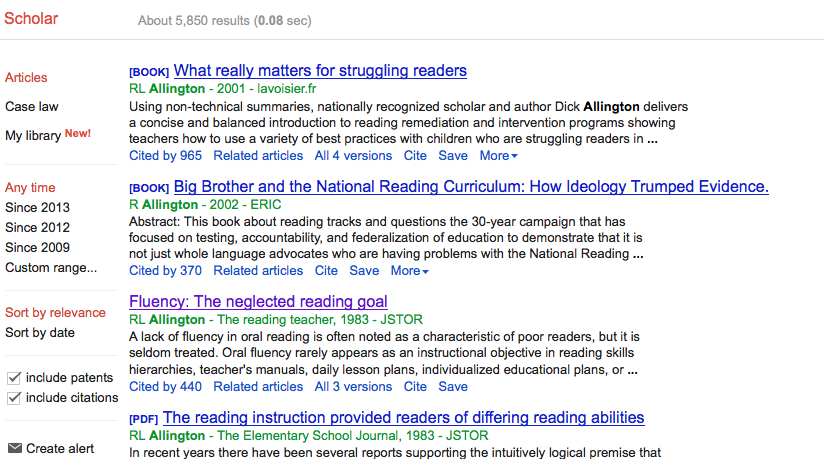

Closed for business: Allington's Google Scholar results list all sorts
of research that will cost you dearly in you want to read it.
Why is he choosing to avoid the national conversation?
In fact, if I use Google Scholar to search for Allington's work, I find links to $25 books and $15 journal articles, and I'm not paying for either, and neither are teachers. I don't know, maybe he assigns his books so his students have to buy them. If I use "regular" Google I find a few "light" pieces available, alongside many costly ink-on-paper books. Again, sorry, no thanks.

RIAA caught stealing copyrighted web code as they pursue
kids who download a song.
Do you want to be part of the conversation or not? That is the question. Many, university faculty, grad students, the Authors Guild, the MPAA, the RIAA, would rather not be. In pursuit of pennies, they are actually seeking irrelevance.

These groups all think they are benefitting their "members," but that's obviously not true. They are all choosing to drive their audiences away. It is not even a tough prediction to suggest that university attendance will nose-dive over the next 20 years, better information than many post-secondary courses offer is available free and in much more engaging forms... That "film" and music distribution will look completely different in five years: Straight to YouTube has become the path for many of our most creative new musicians and film makers... That authors will be publishing free but making money via contribution and performance in less than five years: Free stuff to read is all over the internet, and its a much better collection than you'll buy at your local Barnes&Noble. This is neither "good" nor "bad," it is just inevitable. The distribution system of the 20th Century makes no sense to most anymore. It was clumsy and expensive and enriched the wrong people anyway. The copyright system of the 20th Century makes no sense anymore - it really never did make sense to protect a cartoon mouse as "intellectual property" for ten times as long as a life-changing medication. It also enriched the wrong people - corporations and attorneys rather than inventive minds. So both will go away, and soon.

So, you have your choice. Hide behind paywalls and attack lawyers, or share your works with the world. Be part of the global conversation or confine your thoughts to an increasingly irrelevant elite.
Figure out how to live via a culture of sharing and communication or sit back and imagine royalty checks rolling in.

But realize that the sides are forming now. CBS may eliminate itself from the understood history of global journalism in pursuit of a few cents. Just as the RIAA killed the music CD by charging $14 instead of $3 for that format in 2000. Just as university faculties sit back proudly as their work in "peer reviewed" journals gathers dust and has zero impact on anyone. And if you choose the wrong side you might become the next AOL - remember? They had this brilliant business model...

- Ira Socol

15 January 2013

Kurt Eisner and Aaron Swartz and the Freedom of Information

There's a famous bit of history from 1914. It's called "the blank cheque telegram," and it was sent by the German Imperial Chancellor,  Theobald von Bethmann-Hollweg to the Austrian ambassador in Berlin on the sixth of July.
"Finally, as far as concerns Serbia, His Majesty, of course, cannot interfere in the dispute now going on between Austria-Hungary and that country, as it is a matter not within his competence.

"The Emperor Francis Joseph may, however, rest assured that His Majesty will faithfully stand by Austria-Hungary, as is required by the obligations of his alliance and of his ancient friendship. - Bethmann-Hollweg
Historians suggest this communication allowed the Austro-Hungarian Empire to begin the Great War (World War I). And this telegram did much to "establish" - in British, French, and American eyes, the "German War Guilt" which would explain the massive reparations Germany was asked to pay in order to have peace.

This telegram was in public hands in 1919 because of an obscure political leader, Kurt Eisner, briefly, in 1918-1919, Minister-President of the Bavarian Soviet Republic. Minister-President Eisner believed in many freedoms, including the freedom of information and the call by the American President Woodrow Wilson that, "there shall be no private international understandings of any kind but diplomacy shall proceed always frankly and in the public view." And believing thusly, he dumped the entirety of files of the Bavarian Foreign Office into public view.

Though Bavaria was part of the German Empire, and would be part of the German Republic, it functioned in many ways as the separate kingdom it had been before 1870. It had its own army, its own post office, and though it did not act separately from Germany, its own foreign office. All of Germany's diplomatic correspondence had thus been copied to Bavaria, and thus this Berlin telegram was there...

Eisner is kind of a hero of mine. He believed in democracy deeply, including democracy of the arts and education (he thought new and more diverse playwrites, composers, artists, and authors deserved more exposure), and he believed in a world of open communication.

In the end he was shot, murdered in the street. Diplomacy went back into secrecy.

Ah well.

Here we are in the "now," in the period of Bradley Manning and Aaron Swartz. Of pay walls and locked down internet sites and government prosecutions and the classic midwestern mother bankrupted by the RIAA.

Eisner may have gotten off easy.

In this week after the suicide of Aaron Swartz, about to be tried for freeing publicly-funded research from behind pay walls maintained by the Massachusetts Institute of Technology, we all need to wonder where we stand, and perhaps we need to take action.
'"Now is a time for everyone involved to reflect on their actions, and that includes all of us at MIT," [Leo Rafael Reif, president of the Massachusetts Institute of Technology] wrote. "I have asked Professor Hal Abelson to lead a thorough analysis of MIT’s involvement from the time that we first perceived unusual activity on our network in fall 2010 up to the present. I have asked that this analysis describe the options MIT had and the decisions MIT made, in order to understand and to learn from the actions MIT took."
"Rief added that he will share the report publicly once it has been completed."
Aaron Swartz
Swartz was facing, "a sentence of up to 35 years in jail and $1 million in fines." Which is far more than many killers get, and incredibly severe considering no one from Wall Street in 2008 even was put on trial. Yup. 
Tweet from Sir Tim Berners-Lee, inventor of the web:
Aaron dead. World wanderers, we have lost a wise elder. Hackers for right, we are one down. Parents all, we have lost a child. Let us weep.
Swartz may not be the "inventor of the internet" that CNN called him, "but he was a factor in fashioning some of the Web's upper floors. With his contributions to RSS coding and the Web application framework, Swartz made some of today's more expansive Internet possible. But what Swartz also helped create was a philosophy of the Internet, one that remains the subject of great controversy almost 20 years into its life: the libertarian idea that information wants to be free."

Bradley Manning
Meanwhile, Bradley Manning remains under prison conditions close to torture for, like Kurt Eisner, following Woodrow Wilson's advice.  Because in this country it is the legacy of Michael Eisner, not Kurt, which rules. The Michael Eisner legacy is simple: If you are powerful, you get to profit from the work of others for all time. If you are not, life sucks. Eisner built the Disney empire (ABC, ESPN, etc) by leveraging the copyrights on the work of the long-dead Walt Disney.

"Invent a drug that's a cure for cancer," I tell kids who wonder about copyright law, "and the government will let you own it for a dozen years. Draw a mouse and you've got protection for more than a century."

It's not a system written to encourage the development of intellectual property, and its not a law designed to serve our nation or or world. It is a law written by greedy slobs who've never invented anything, but want to live well in perpetuity off the labors of others.

In the Manning and Swartz cases the issues are particularly absurd. Bradley Manning blew the whistle on horrific military and diplomatic practices. Aaron Swartz freed intellectual content, not from the author/researchers, but from companies like Elsevier who profit simply because moronic university tenure committees prefer pay-walled journals to open sourced journals and blogs.

There is plenty of blame to go around. The United States Justice Department, United States Attorney General Eric Holder, President Barack Obama, the administration of the Massachusetts Institute of Technology, the Disney Corporation (ABC/ESPN/Miramax/et al), The RIAA, Elsevier and other journal publishers, the members of the Authors' Guild of America, and many more people and organizations who should be held accountable. This group includes the faculties of our research universities who encourage paywalled publishing which benefits only the egos of those who grant PhDs and faculty tenure.

But there are also plenty of fixes possible. Some require new laws, some require personal efforts:
  1. Limit copyright protection to 35 years - or less (sign White House petition here)
  2. Require that academic research resulting from any form of public funding be published openly and remain freely available (sign White House petition here). This does not suggest that academics cannot create books which are paid for, simply that their research findings must be available.
  3. Limit any court judgment for online copyright "theft" (downloading content) to double the retail cost of that content.
  4. Fire US Attorney Carmen Ortiz, the prosecutor of Aaron Swartz (sign White House petition here).
  5. If you are an academic, stop citing any article not freely available. This is not only the "right thing to do" on this issue, but it is the only way that allows most people to vet your work.
  6. If you are an academic, post everything you've written to free sites.
  7. If you are an academic, require open publishing for both hiring and tenure.
  8. Refuse to purchase books written by members of the Authors' Guild - singled out for the viciousness of their attacks on even disability access.
  9. Consider whether you really want to support musicians whose work is protected by the RIAA.
  10. Extend full legal protection to military - and other government - whistle blowers.
This is important. Information wants to be free. And it is up to us to make that so.


- Ira Socol

26 February 2009

Why Roy Blount Jr. is evil...

Can Amazon's Kindle 2 read books to you?

Many of us who work in the field of literacy have been waiting for this moment. We've been waiting for Text-To-Speech to go fully mainstream, because, as this happens, access to information, to our culture, is no longer limited to the elite, to those with excellent alphabetic decoding skills, to the recipients of high-quality education.

I, as an author, refused to make my book Kindle-available before, because it was not an accessible format. I opted instead for an accessible PDF version available through Lulu.com. But now, I'll probably find the time to make a Kindle2 version possible.


But other authors feel differently. A group of self-appointed "copyright defenders" called the "Authors Guild" deeply objects to the expansion of reading. Led by their president, an author of the kind of books which lie near toilets across America (we might call this "second rate blog quality") named Roy Blount, Jr. they are insisting that Text-To-Speech systems violate their copyright. And while doing that, Mr. Blount decides that he is an expert on disability - and will (I guess personally) diagnose those worthy of assistance.

Let's "read" what Mr. Blount had to say in The New York Times:

"In fact, publishers, authors and American copyright laws have long provided for free audio availability to the blind and the guild is all for technologies that expand that availability. (The federation, though, points out that blind readers can’t independently use the Kindle 2’s visual, on-screen controls.) But that doesn’t mean Amazon should be able, without copyright-holders’ participation, to pass that service on to everyone.

"The guild is also accused of wanting to profiteer off family bedtime rituals. A lawyer at the Electronic Frontier Foundation sarcastically warned that “parents everywhere should be on the lookout for legal papers haling them into court for reading to their kids.”

"For the record: no, the Authors Guild does not expect royalties from anybody doing non-commercial performances of “Goodnight Moon.” If parents want to send their children off to bed with the voice of Kindle 2, however, it’s another matter."

So, hear the Authors Guild clearly, despite their "denials": If the Authors Guild decides that you are "disabled enough" you can have Text-To-Speech. And if your parents are literate and able to read to you in English the Authors Guild will allow you access to bedtime stories. That is quite nice of them, isn't it?

Soon, we can expect, Roy Blount, Jr. will oppose libraries, because, if you can't afford the book, you can't have it either. Don't think so? This is a guy who who'll pull the bedtime stories away from kids of parent's with reading problems. He's quite capable of doing anything.

Listen. I wish my book was making a lot of money. I really do. But what I wish most is that people were reading it. That's why I wrote it - because I had a story I wanted to tell.

Yes, I'd like to get paid for it. But even if I did, sorry, I don't expect one piece of creation to support me forever. So copyright is a good thing, but it should never be a lifetime thing or an absolute thing. Right now Roy Blount, Jr.'s Am I Pig Enough for You Yet? already enjoys far more legal protection than medicines which take billions of dollars and years of research by thousands to create. Now I'm no fan of "big pharma" but medications get far less patent protection time than books get copyright protection time, and pharmaceuticals are passed out for free far more often than books are.

If we believe that books are important, and I think all authors should think that, then we want people to read. And it should make no difference at all how that book is read. If someone wants to buy The Drool Room, on paper or by download, or - if I get it together - on Audiobook or Kindle2 sometime this year, I don't care whether they decode the printed words, or listen to it on an electronic device, or have a friend read it to them, or touch Braille with their fingers. I don't care if they pass the book to a friend when they're done, I don't care if six people are in the car while it is being read, and any author who does is no artist in my mind, and is no supporter of literacy.

Access to information is one of the most important social justice issues of this century. And access is constantly being threatened by short-sighted, money-deperate people like the RIAA and the Authors Guild. So here's what I'd like you to do: Obviously, boycott Roy Blount, Jr.'s books. And someone, please, find and post an Authors Guild membership list so we can expand the boycott and increase the pressure.

Because if we can't even have authors united in supporting universal access to literacy, we'll never convince educators.

- Ira Socol

here's a shorter blog argument.